This year something changed in my sweetcorn patch.
The plants were taller, stronger, greener – and twice the size of those in our community garden down the road. And the harvest was superbly sweet and succulent as we ate it, freshly barbecued, dripping with butter.

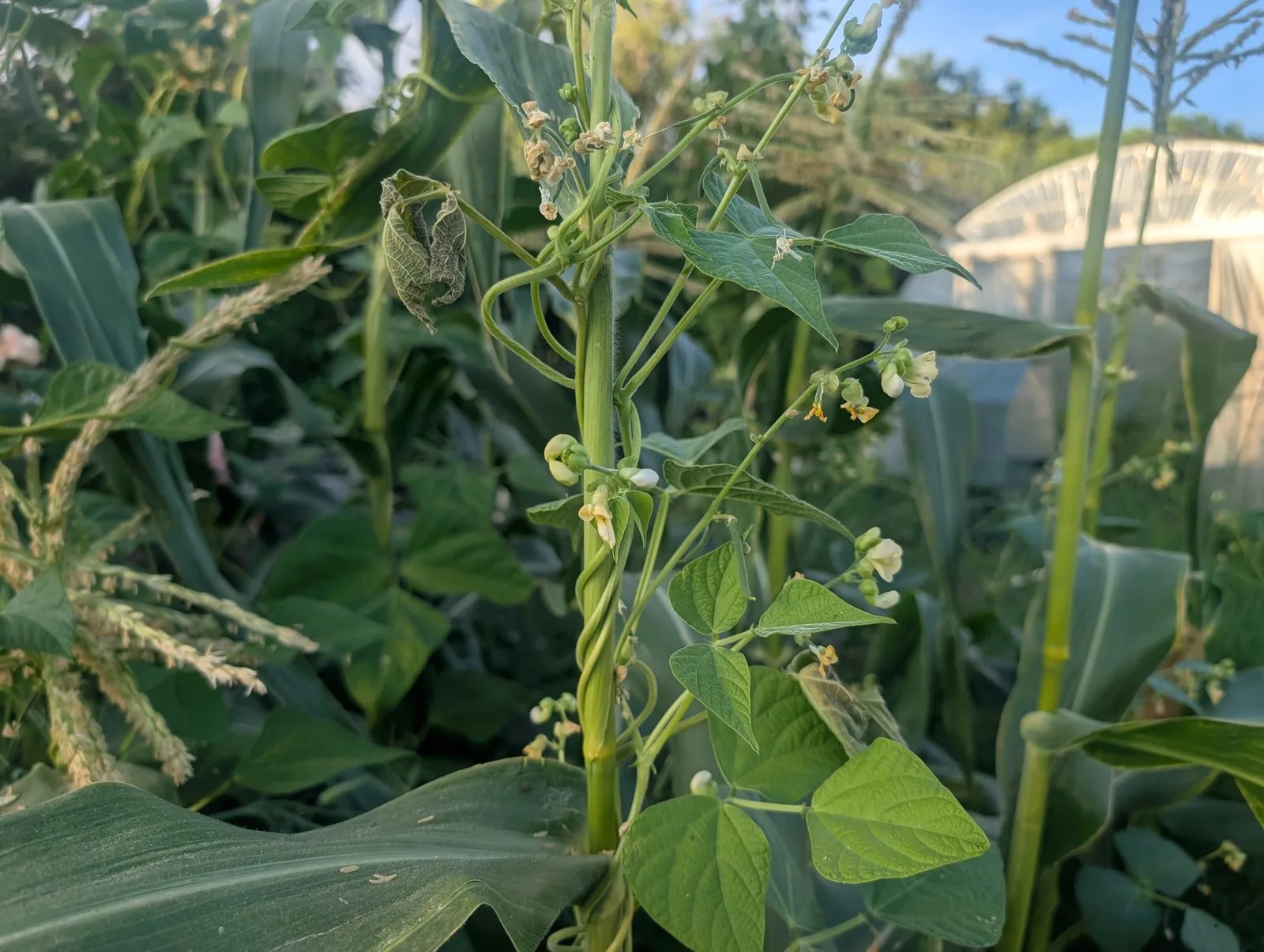
It was also the first time I’d successfully grown beans up sweetcorn plants. French and borlotti beans, twisting round the plants, dangling their produce in delightful green and mottled red – occasionally getting too enthusiastic and bending the sweetcorn plants over at the top.
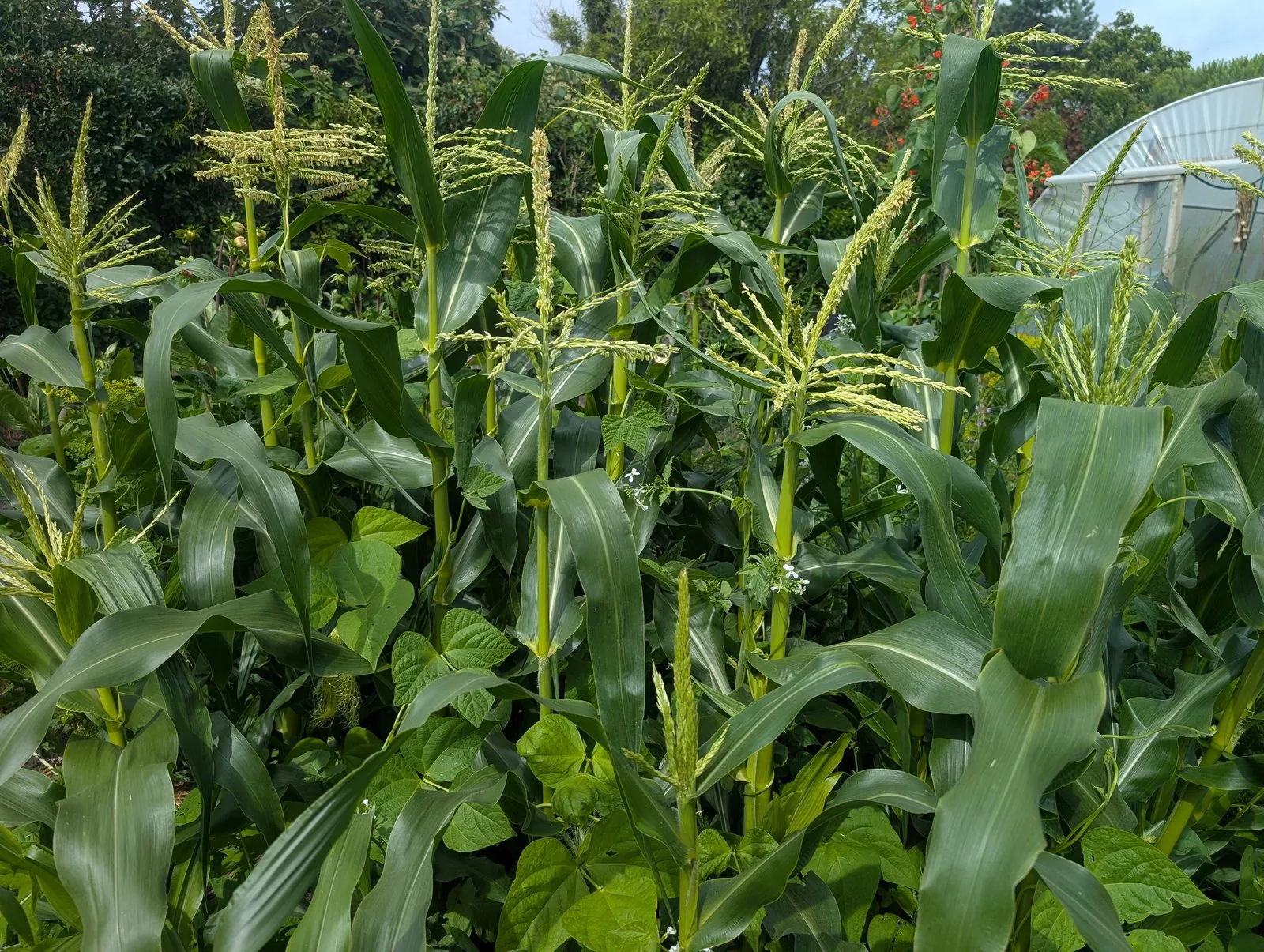
Was it the beans, or some other factor? After hearing of research that says legumes share more nitrogen than previously thought, I decided to dig in and have a look at the evidence.
Beans – good now, or good later?
The wonderful thing about legumes is that they can fix nitrogen from the air, storing it in their roots.
However, for years, I’ve believed that the benefit of beans came not immediately, but later, with the nitrogen released from their root nodules as they rot away, enriching the soil for the next year’s planting. (Assuming, of course, that you don’t rip the roots out.)
That is the traditional advice, too. The Royal Horticultural Society says green manure releases nitrogen back into the ground when dug in, while Garden Myths states:
“Legumes are highly touted as a great companion plant because they add nitrogen to the soil for the partner plants. This is simply not true.”
In fact, we’re often advised to cut green manures before they flower, on the basis they will otherwise use up much of their nitrogen fruiting.
What we can glean from the research
It’s not one study but several that show beans share nitrogen with other plants. But the devil is in the details.
For example, one study found that when pea and triticale were grown together, about 7% of the nitrogen leaked by the pea ended up inside the cereal [1]. Another study found that when maize was grown with soya beans, it took up 3% more nitrogen than when the two crops’ roots were kept apart [2].
Different numbers – partly, it seems, because some plants get more nitrogen than others.
Grasses, for example, seem to do particularly well out of legumes [3]. In one study, clover released 5.3% of its fixed nitrogen when grown alongside ryegrass, but just 3.5% when grown alone [4].
The same review found that a legume in pasture supplied up to 73% of a grass’s nitrogen [3], but that was a perennial system with years of root turnover, so it’s unlikely a three sisters bed would get anywhere near it.
(That seems to be good news for sweetcorn, which is itself a grass. No-one seems to have measured the impact on squash, unfortunately.)
The exchange may also be two way, with some research suggesting that cereal sends phosphorus signals back to the legume in return for nitrogen [5].
That nitrogen release isn’t static. Nodules on the roots of legumes are continually growing, dying and being replaced with new ones.
As the beans flower and pod, more root nodules die off and release nitrogen.
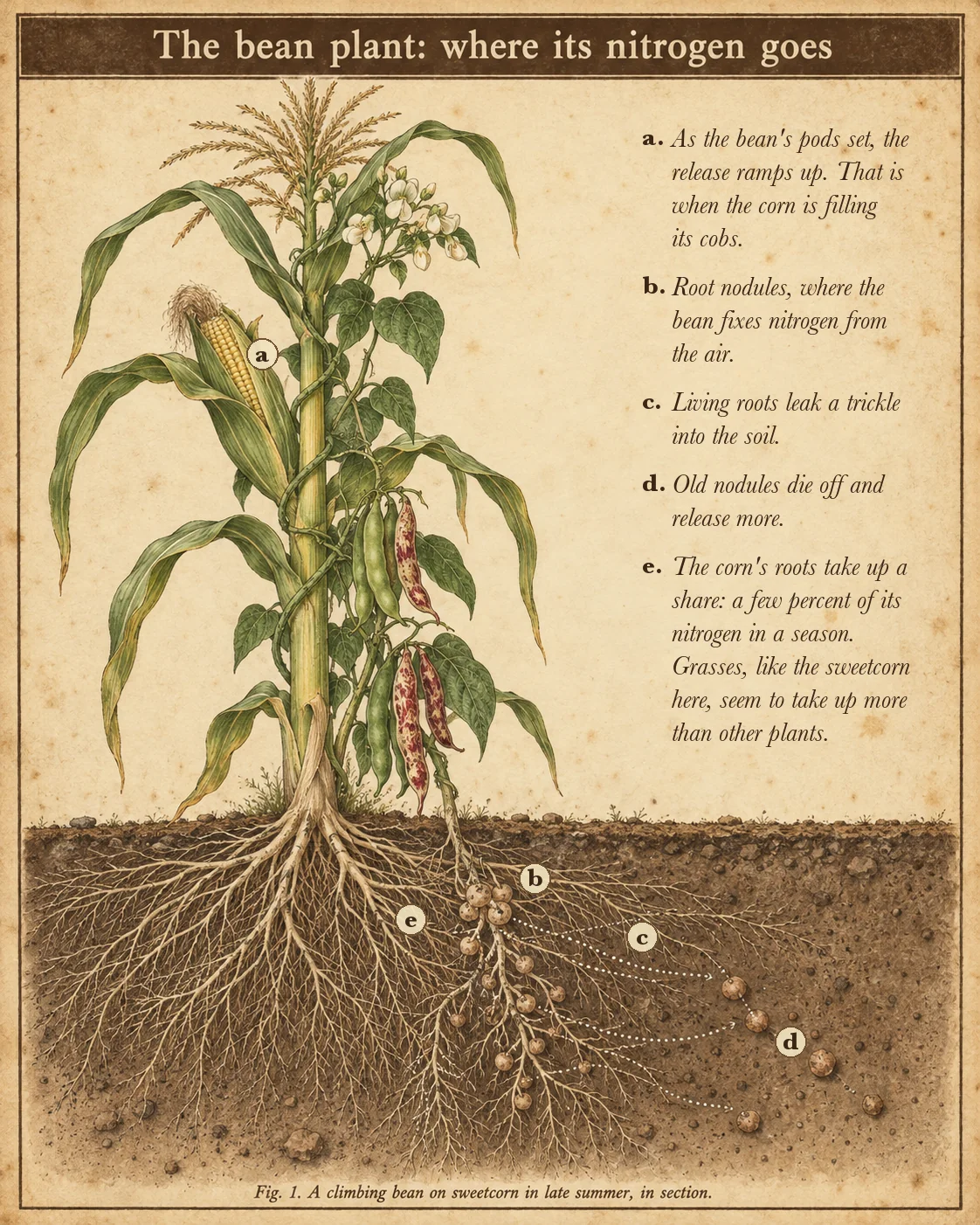
This is handy for the sweetcorn. When its roots first meet those of the legume*, it gets a smidgeon of nitrogen, but as the summer goes on it gets more. In a three sisters bed, that’s likely to be July and August, when the corn is swelling and demanding nitrogen the most.
Why I can’t be sure beans actually made any difference
So was it the beans that led to my superb corn harvest?
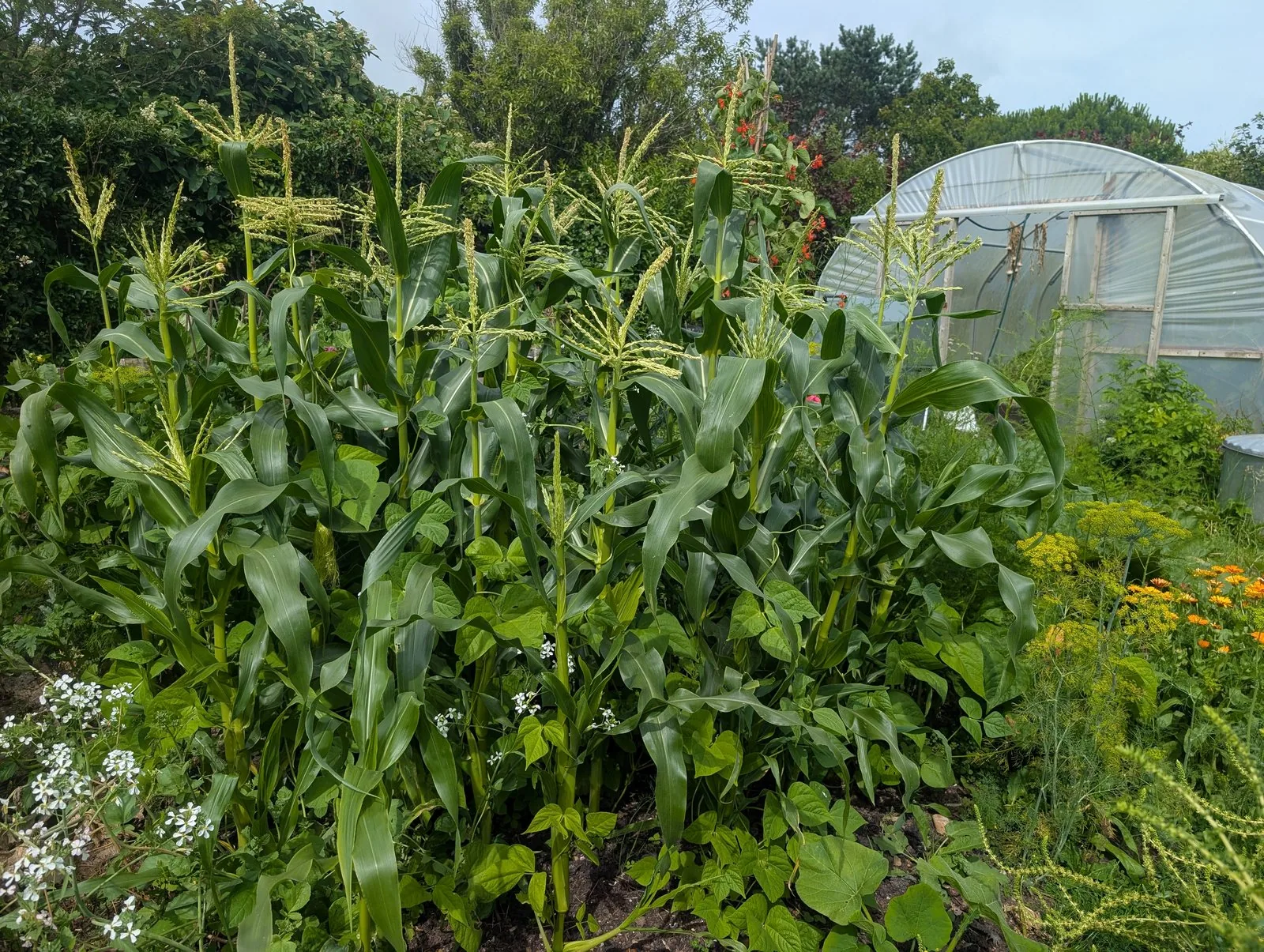
After looking through the research, I’m still not sure. Studies suggest that legumes pass on some nitrogen to some crops, but most suggest it’s not much.
I’d take any single nitrogen transfer figure with a pinch of salt, because the results are all over the place. A review of different studies found that reports of nitrogen leaving the plant ranged from just 4% all the way up to 71% (note that not all the nitrogen that leaves the plant finds its way to its neighbour).
My own single experience certainly doesn’t add to my certainty. Maybe the beans helped – or maybe I added slightly more manure than last year. Most likely, it was the long, hot summer that made the difference.
I’m not sure I mind. The beans growing in my corn look great, they taste great and their roots improve the soil for the future. The possibility that they might give a short-term nitrogen boost at the same time is just an added bonus.
*Studies are divided on whether the nitrogen transfer occurs primarily via direct root contact or via fungal networks.
Sources
[1] Hupe, A., Naether, F., Haase, T., Bruns, C., Heß, J., Dyckmans, J., Joergensen, R. G., & Wichern, F. (2021). Evidence of considerable C and N transfer from peas to cereals via direct root contact but not via mycorrhiza. Scientific Reports, 11. https://doi.org/10.1038/s41598-021-90436-8
[2] Zhang, H., Zeng, F., Zou, Z., Zhang, Z., & Li, Y. (2017). Nitrogen uptake and transfer in a soybean/maize intercropping system in the karst region of southwest China. Ecology and Evolution, 7(20). https://pmc.ncbi.nlm.nih.gov/articles/PMC5648690/
[3] Thilakarathna, M. S., McElroy, M. S., Chapagain, T., Papadopoulos, Y. A., & Raizada, M. N. (2016). Belowground nitrogen transfer from legumes to non-legumes under managed herbaceous cropping systems. A review. Agronomy for Sustainable Development, 36, 58. https://doi.org/10.1007/s13593-016-0396-4
[4] Lesuffleur, F., Salon, C., Jeudy, C., & Cliquet, J.-B. (2012). Use of a 15N2 labelling technique to estimate exudation by white clover and transfer to companion ryegrass of symbiotically fixed N. Plant and Soil. https://doi.org/10.1007/s11104-012-1562-3
[5] Li, R., Niu, Z., & Niu, H. (2026). Interspecific nitrogen transfer and nutrient exchange in legume-cereal intercropping systems: A review. Regional Ecology and Management. https://www.sciltp.com/journals/rem/articles/2602003125