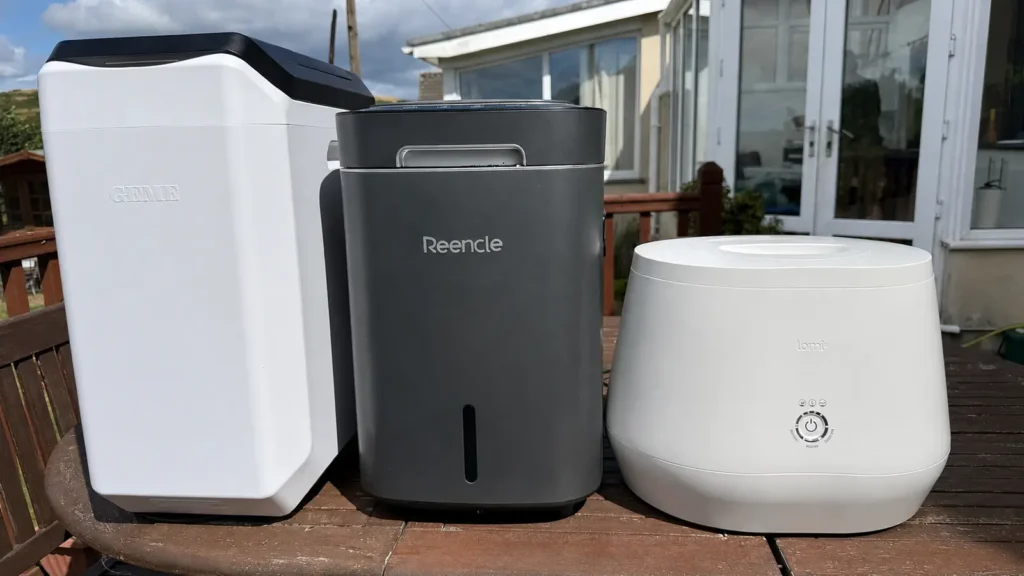
Enter my kitchen and you might hear a low hum coming from a box in the corner.
It’s not an alien monster eating my food waste, it’s something which calls itself an electric composter. The one I’m currently testing produces a dry material that looks like sawdust, and it’s highly questionable whether it should actually be called a composter.
But other devices I have tested have produced something that certainly looks and smells like fresh compost.
(This article covers the science. If it’s buying advice you’re after, see our guide to the best electric composters.)
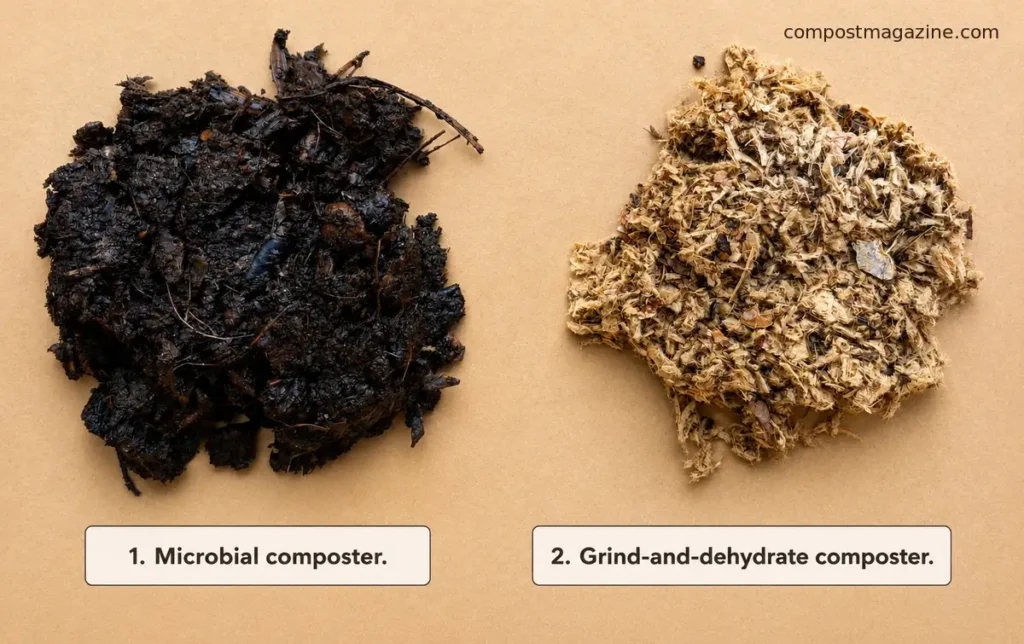
There’s a paucity of independent research into electric composting, and what exists primarily focuses on outdated grind-and-dehydrate models.
So drawing on my own in-house use of these devices, what little published research there is and an interview with Oliver Wang, Chief Environmental Scientist of Geme.bio, here’s what I know so far.
The role of the microbes
Compost microbes occur naturally in the environment. If you pile up material, and the conditions are right, the material will break down whether or not you add a starter material.
That’s not to say you can’t speed the process up. Scientists are continuously experimenting with different inoculations for improved composting, while many professional composters swear by adding soil or compost to a new batch to speed up the introduction of the right bacteria.
Both the Reencle and the Geme Terra II aim to do the same by introducing an optimal bacterial mix. However, Oliver pointed out to me that this bacterial community won’t stay the same:
“Food brings its own microbial population into the chamber, and the community inside Terra II continues to change with the feeding pattern.”
Creating the right conditions
Microbes are only one part of the composting problem. For the right microbes to thrive, they need the right amounts of warmth, moisture, oxygen and compost at a size they can digest, as well as a mixture of both carbon and nitrogen.
Oliver told me:
“One of the clearest lessons from our R&D work was that strain selection alone could not deliver consistent performance.”
“The microbial culture matters, but the physical microenvironment is more complex than it first appears. Two systems can show a similar average temperature while having very different moisture distribution, airflow and biological performance.”
But that’s not as simple as it sounds, as electric composters need to deal with a number of challenges:
- Food is constantly added and mixed throughout the process. This contrasts with many traditional composting processes, where material is built up and then proceeds at the same time through the mesophilic, thermophilic and maturing phases.
- Fat from kitchen materials coats particles, making it more difficult for oxygen to reach it.
- The food constantly releases water, making it challenging to maintain moisture levels. This is particularly challenging when wet food waste is broken down, as excessive moisture can fill up pore spaces and restrict oxygen use. Geme deal with this by aiming for effective mixing rather than fine grinding.
- They need to handle a higher quantity of salinity than typical garden compost material because of the amount of salt used in cooking [2].
(Note that despite this I’ve found with the Geme Terra II that I need to add water on a very regular basis. My working theory is that this is because the bacterial mix, combined with optimum conditions, is more aggressive than with a traditional compost pile.)
Writing in BioCycle, soil amendment consultant Ron Alexander had the output of three machines tested at an independent lab, and also found salts to be a problem [3]. Still, Geme tell me they have partially solved the salinity issue, with caveats:
“Terra II is designed to handle the normal variation found in household leftovers, including reasonable amounts of salty or oily food. That should not be interpreted as unlimited tolerance for brine, cooking oil, concentrated sauces or repeated high-salt inputs.”
Oliver recommended taking steps to deal with high levels of salts, such as draining excess brine and avoiding excessive amounts of salts in a single go.
Best Electric Composters for 2026
We spent months testing electric composters in our own kitchen. The two in this guide make real compost, not dried scraps.
View Guide →The carbon issue
Manufacturers have some control over at least the initial microbial community, and a lot of control over the conditions their technology has created.
But what they can’t control is what users add to the composter.
It’s an issue highlighted by one of the few independent studies into electric composters [1]. It’s this study looked at the results of a grind-and-dehydrate model, the same breed of machine as the one currently turning my food waste into sawdust, but it has some common sense advice: improve the initial carbon nitrogen ratio of compost material in order to produce better results.
That might be hard to explain to users, especially when simplicity is a key selling point of the device. Perhaps what suppliers can do, though, is simplify that advice by suggesting that users mix in high carbon kitchen waste such as used paper towels, stale bread and uneaten pasta to get better final results.
Using tech to improve results
One thing companies can do now is use advanced tech to improve results.
Here again, things are not as simple as simply measuring a single indicator. For example temperature could change because of microbial behaviour, but it can also change because of the air temperature. The technology also has to deal with the fact that the materials in the composter are at different levels of decomposition.
Because of this, Oliver explained, scientists need to combine a range of different signals, and look at how those signals change over time, in order to accurately gauge the progress of the compost and create the optimum conditions for the compost at that time.
Even then, Oliver says, there are limits with what current technology can detect:
“GEMEBrain manages the process state; it does not replace laboratory maturity testing.”
Which brings us to the thorniest question of the lot.
The maturity issue
The second issue that Azis found was compost maturity. Some electric composter brands either state or imply that compost is immediately ready when the process is finished.
That’s not so. Fresh compost, whether from a compost pile or an electric composter, that has not had the time to mature is typically phytotoxic [2]. So it’s not surprising that Azis’s experiments, though not using compost from a microbial composter, had appalling germination rates.
(The best two of the six carbon-to-nitrogen mixes Azis tested returned germination indices of just 16.2 and 31.8, and phytotoxins were still present after four weeks of curing.)
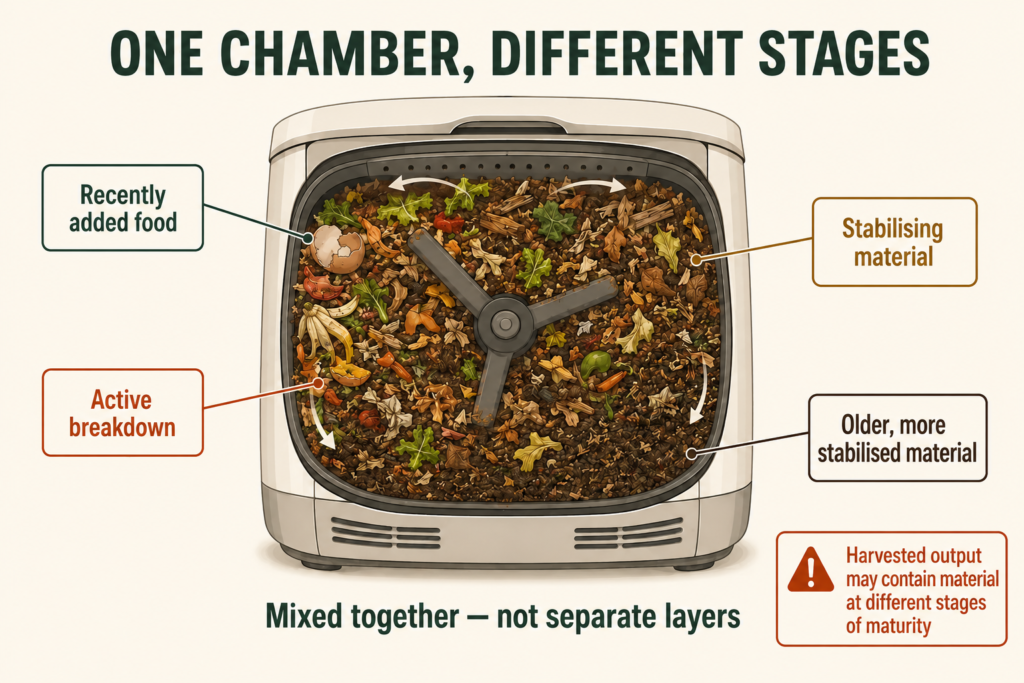
Even when users retrieve compost which has spent some time in a composter, it’s likely to be a mixture of mature and immature elements.
Again, there’s practical considerations to be thought of here. Harvesting compost and leaving it for 6 months before using is not a strong selling point! Geme deals with this by recommending mixing it with soil by one part to eight. Reencle’s own published guidance pairs the two, recommending a one to four mix with soil and at least three weeks of drying or ageing before the output goes near plants.
Geme also caution against using their output as a growing medium on its own, and specifically against putting it anywhere near seedlings or salt-sensitive plants.
Perhaps electric composter companies could finesse their advice by suggesting that while users can use compost immediately if it is sufficiently diluted (as Geme do) they could alternatively leave the compost to mature for several months before using it as potting compost, which is closer to the timescale I’d want before potting up myself.
The research gap
Even with manufacturers, more research needs to be done. Both Geme and Reencle have tested their results and shared their data with me, but Geme is upfront about the need for more data.
The data we have published so far has focused mainly on output composition, including organic matter, nutrients and pH, together with instrumented observations of the decomposition process.
We have not yet published a standardised CO₂ respiration, oxygen-uptake or volatile-solids-reduction dataset for Terra II output that we would ask an independent reviewer to treat as conclusive evidence of stability.
While I look forward to additional data from manufacturers, I’m hoping for independent data from researchers.
That’s because after using these devices, even at an early stage in their development, I’m really excited about them.
It’s easy for keen gardeners and composters to look down their nose at them, but the opportunity to bring microbial composting to apartment and gardenless home owners who would have previously chucked their waste into the trash is too good to miss.
Independent testing and corroboration, along with recognised and shared standards that Geme is now calling for, can only help the process.
Sources and disclosure
Disclosure
While no payment was accepted for this article, Compost Magazine receives a commission on products it recommends, including the Geme Terra II and the Reencle. Geme answered my questions in writing and their answers are reproduced in full below. They had no sight of this article before publication and no editorial input into it.
References
[1] Azis, F. A., Choo, M., Suhaimi, H., & Abas, P. E. (2023). The Effect of Initial Carbon to Nitrogen Ratio on Kitchen Waste Composting Maturity. Sustainability, 15(7), 6191. https://doi.org/10.3390/su15076191 (This study tested a grind-and-dehydrate machine, not a microbial one.)
[2] Du, S., Ding, S., Wen, X., Yu, M., Zou, X., & Wu, D. (2024). Investigating inhibiting factors affecting seed germination index in kitchen waste compost products: Soluble carbon, nitrogen, and salt insights. Bioresource Technology, 406, 130995. https://doi.org/10.1016/j.biortech.2024.130995
[3] Alexander, R. (2024, October 22). Analyzing the outputs: Kitchen appliances vs. facility-composted food scraps. BioCycle. https://www.biocycle.net/kitchen-appliances-vs-facility-composted-food-scraps/
Interview
Oliver Wang, Chief Environmental Scientist at Geme. Conducted in writing, August 2026. Full transcript below.
About the machines
Geme, the Terra II and the Kobold starter material.
Related reading
- Are electric composters worth it?
- Geme Terra II review
- Reencle Food Waste Composter review
- The carbon to nitrogen ratio in composting
The full Geme interview
Read the full written interview with Oliver Wang, Chief Environmental Scientist at Geme
How much of the effect is Kobold [starter material] itself versus the environment it creates?
The two are closely connected.
Kobold provides the biological starting capacity. It introduces a prepared microbial community that can begin working across a broad range of normal kitchen waste, rather than leaving the system entirely dependent on whichever microorganisms happen to arrive with the food.
It does not sterilise the input or permanently exclude every microorganism already present. Food brings its own microbial population into the chamber, and the community inside Terra II continues to change with the feeding pattern.
Terra II provides the conditions that make this biological activity more consistent: oxygen, moisture management, temperature support and regular contact between the microbes and the food.
A capable microbial culture cannot perform well for long if the material becomes waterlogged, compacted, oxygen-limited or excessively dry. Equally, a well-controlled environment without a reliable starting community would usually produce a less predictable start-up and a greater variation between different food types.
The simplest way we describe it is: Kobold provides the biology; Terra II provides the conditions that allow it to work consistently.
Where does Terra II sit in relation to mesophilic, thermophilic and curing stages?
A traditional batch compost pile may move broadly from a mesophilic phase into a thermophilic phase, then cool and cure.
Terra II does not move through those stages as one single mass. Because it is continuously fed, different parts of the material can be at different stages at the same time.
Fresh, room-temperature food may pass through a local mesophilic transition after it is added. The established active matrix operates mainly in a higher-temperature biological range, generally around 45–55°C. Older material is meanwhile moving into a lower-rate stabilisation phase.
We would not claim that every part of the chamber remains at exactly the same temperature, or that every particle reaches the same degree of maturity at the same moment. Local moisture, porosity, food composition and airflow all affect the process.
The harvested material is a biologically processed, concentrated compost output. It is not simply dried or ground food waste. At the same time, it should not be treated as uniform, inert potting soil.
For normal garden use, we recommend mixing approximately one part GEME output with eight parts soil and covering it with at least 5 cm of soil. We do not recommend using fresh output as the sole growing medium, particularly for seedlings or salt-sensitive plants.
A continuous system does not have one single moment when every particle becomes equally mature.
Have you tested CO₂ respiration or volatile solids reduction?
We agree that respiration, oxygen-uptake and volatile-solids testing would provide stronger evidence of biological stabilisation than appearance, heat or weight reduction alone.
The data we have published so far has focused mainly on output composition, including organic matter, nutrients and pH, together with instrumented observations of the decomposition process.
We have not yet published a standardised CO₂ respiration, oxygen-uptake or volatile-solids-reduction dataset for Terra II output that we would ask an independent reviewer to treat as conclusive evidence of stability.
We do have clear process evidence of active biological decomposition, but we do not treat process heat, visible breakdown or mass loss as substitutes for a standardised endpoint test. Weight loss alone cannot distinguish water evaporation from biological conversion of organic matter.
Continuous systems also create a sampling challenge. A sample taken shortly after a large food addition will not have the same material age as a sample taken from the established compost matrix. A meaningful study therefore needs a defined feed profile, sampling position, material age and conditioning period.
Standardised respiration or oxygen-uptake testing, together with volatile-solids analysis under a controlled feeding and sampling protocol, is one of the areas we are prioritising for the next validation stage.
Has salinity or EC come up in testing?
Yes. It is an important issue in any system that concentrates food-derived material into a relatively small output volume.
Salts do not biodegrade in the way carbohydrates, proteins and fats do. As organic carbon is metabolised and water leaves the system, soluble minerals can become more concentrated. EC may therefore rise even when the biological process itself is operating normally.
Terra II is designed to handle the normal variation found in household leftovers, including reasonable amounts of salty or oily food. That should not be interpreted as unlimited tolerance for brine, cooking oil, concentrated sauces or repeated high-salt inputs.
Our practical advice is to: drain excessive brine, soup or sauce before adding the solid food; avoid pouring cooking oil directly into the chamber; divide unusually salty or fatty food across several feedings; maintain a varied input mix rather than repeatedly feeding one concentrated waste type; and mix the harvested output with soil at the recommended ratio rather than using it undiluted.
Salt and fat also create different problems. Salt is mainly a concentration and plant-use issue. Excess fat can coat particles, restrict air and water transfer, and temporarily slow aerobic decomposition.
We are now looking at EC across defined feeding profiles rather than treating one isolated output sample as representative of every household diet.
Salt does not biodegrade, so the responsible answer is good input management and appropriate soil dilution.
What did R&D find mattered more or less than expected: the culture or environmental control?
One of the clearest lessons from our R&D work was that strain selection alone could not deliver consistent performance.
The microbial culture matters, but the physical microenvironment is more complex than it first appears. Two systems can show a similar average temperature while having very different moisture distribution, airflow and biological performance.
Food releases water as it decomposes. Material can settle, become denser or create local areas where air no longer moves effectively. This means that moisture distribution, porosity, mixing resistance and the actual route taken by the air can matter as much as the headline temperature.
We also learned that holding one exact temperature is less important than maintaining a suitable operating window and recognising when the system is moving away from it.
More heat is not automatically better. Heat can support biological activity, but it cannot replace oxygen, moisture balance or effective contact between the microbes and the food.
Particle size follows the same principle. Reducing size can improve microbial access, but excessive breakdown of wet food into a dense slurry can reduce effective pore space and restrict oxygen transfer. Terra II therefore uses controlled mixing rather than treating fine grinding as the objective.
The culture provides metabolic capability. Environmental control determines how reliably that capability is expressed.
What is GEMEBrain reading to decide that a cycle is done?
Strictly speaking, GEMEBrain does not decide that the entire contents of Terra II are “done”, because Terra II is not a single-age batch.
It reads a combination of signals, including temperature behaviour, moisture-related conditions, changes in load or mass, mechanical resistance during mixing and the recent operating history of the machine.
The important point is that it looks at how those signals change together over time, rather than relying on one threshold or a fixed countdown.
Temperature can rise because of microbial activity, auxiliary heating or a change in room conditions. Mechanical resistance can change because the material is wetter, denser, more fibrous or unevenly distributed. Moisture-related signals also need to be interpreted in the context of what was recently added.
GEMEBrain uses these combined trends to adjust aeration, heat and mixing intensity. As the strong response associated with a recent addition begins to settle, the system can move from more active intervention towards a lower-intensity maintenance state.
That is an operational judgement about the condition of the composting bed. It is not a laboratory declaration that every particle has reached the same maturity.
GEMEBrain manages the process state; it does not replace laboratory maturity testing.
What is next on the testing roadmap?
Our next-stage work is focused on making the performance of the system more measurable, reproducible and independently verifiable.
The main priorities are: standardised CO₂ respiration or oxygen-uptake testing; volatile-solids reduction under defined feeding and sampling conditions; EC and salinity testing across representative household feed profiles; germination and plant-response testing at different compost-to-soil ratios; repeatability testing using defined mixed-food inputs rather than selected single ingredients; controlled comparisons between microbial inoculation and environmental control; and stress testing involving temporary high-moisture, high-fat and high-salt inputs.
We expect this work to combine internal instrumented trials with independent laboratory analysis. Internal testing is necessary for understanding how the control system responds in real time. Independent testing is better suited to verifying output properties against defined methods.
We also want to be more explicit about test boundaries. A result produced from one feed composition, one sampling time or one set of environmental conditions should not automatically be presented as a universal claim.
When we publish further results, our intention is to show the feeding assumptions, sampling method and limitations alongside the headline figures. It is less convenient than presenting one simple number, but it is the only way to build a credible evidence base for a household biological system.
Best Electric Composters for 2026
We spent months testing electric composters in our own kitchen. The two in this guide make real compost, not dried scraps.
View Guide →