
Affiliate Disclosure: This review contains affiliate links. If you purchase through these links, we may earn a small commission at no extra cost to you. This helps support our testing work. GEME provided the Terra II test unit free of charge; they had no say over what we wrote.
I used to turn my nose up at electric composters. Then I was sent one to actually try.
Not the standard grind and dehydrate models, mind. Instead this was one of a new but still rare breed of electric biocomposters which uses actual microbes to turn food waste into compost.
Now I think that for the right person – someone who wants a fast, efficient way to get rid of kitchen waste and get some actual compost out of it at the same time – this is a good option.
So with that in mind, and after months of in-kitchen testing, here are my top two choices (there really aren’t that many microbial electric composters to choose from!) for 2026.
GEME Terra II: Up to 2kg of waste a day
The GEME Terra II works fast, makes actual compost and has lower running costs than competitors. It performed well in our tests, handling kitchen waste including meat and thick sauces. It could even handle small bones - although this took a while.
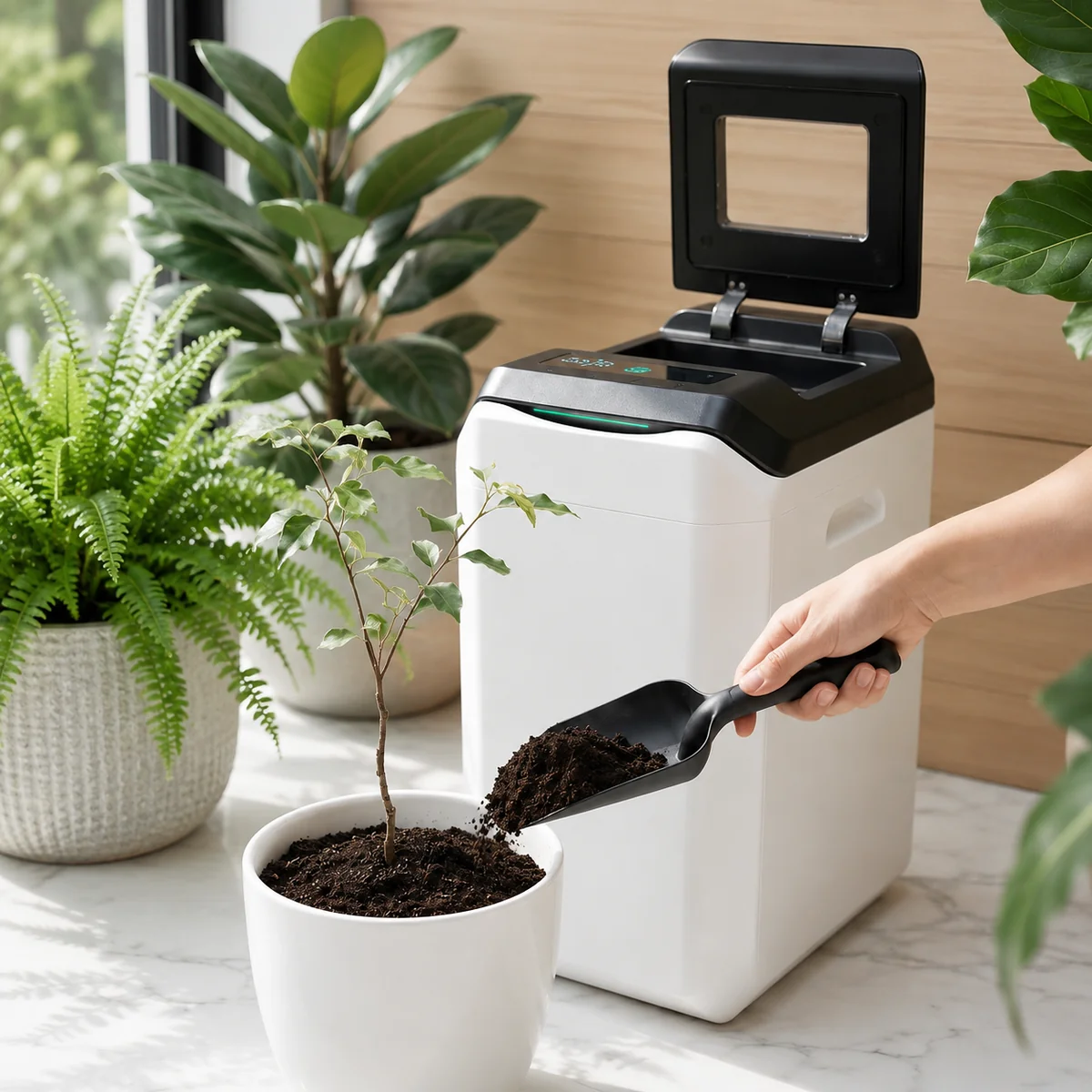
Buying one? We blagged Compost Magazine readers 5% off. It comes off automatically at checkout when you use our link.
Our Testing Notes
The biggest issue I had with the GEME Terra II is the height. In comparison to the Reencle, it was too high to sit on our countertop and we had to move things around in our kitchen in order to fit it in.
That said, it’s actually a touch narrower than the Reencle (27 cm vs 33 cm across) – the bulk is in its depth and height, so it’s counter depth and headroom you need to check, not width.
One advantage it has over the Reencle is a permanent filter which doesn’t need replacing. That doesn’t mean no running costs, though. In addition to electricity (around the same as a fridge, and a little bit more than the running costs of the Reencle) GEME do suggest you buy their compost starter material, Kobold, roughly once a quarter.
Apart from that, and nearly four months into testing, I am impressed so far. The mix of 46 different microbes contained in the starter material breaks down material quickly and aggressively. It can also handle more waste than the Reencle – when I added 1.7kg of waste, it broke down in hours. I also like the use of smart sensors, which allows the device to adjust factors like warmth to match the progress of the compost.
The GEME also handles an impressive range of materials. I had no problem with meat, for example, and small chicken bones caused no issue with operation – although these did take quite a while to break down. (Remember, though, that bones are extremely challenging to compost.)
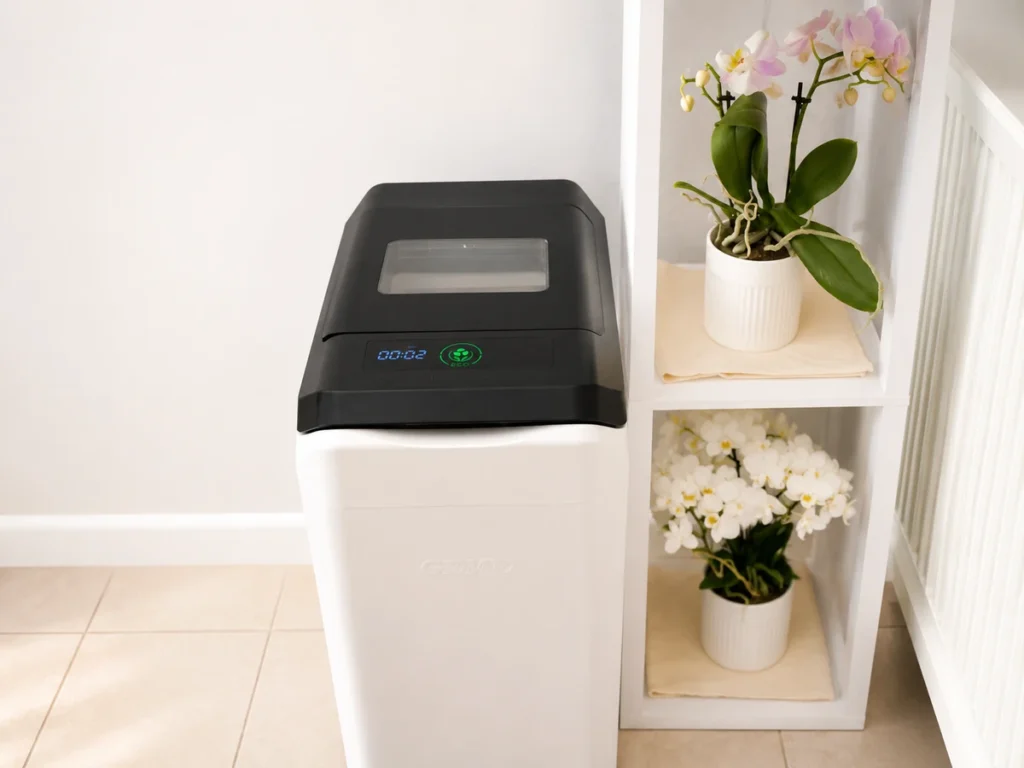
You’ll love this if: You are looking for a kitchen composter that can quickly turn large amounts of kitchen waste into compost.
Alternatives: Choose the Reencle for stunning looks and a smaller footprint.
See the Terra II in action:
Reencle Electric Composter: Tried & Tested
Unlike most electric composters, the Reencle produces real compost rather than just drying food waste. It’s a good fit for anyone who wants to compost indoors.

Our Testing Notes
The Reencle was the first kitchen composter I’ve used that turns waste into actual compost. Not a tiny amount either – I took several buckets out over the months I used it.
That said, while this would be enough for potted plants and a small raised bed, don’t expect this to feed a vegetable garden. For that, you’d need an outdoor composter. The real benefit of this device is that you can get rid of kitchen waste fast and efficiently – and with low odor thanks to the filter and activated charcoal.
We loved the aesthetics of the device, and the wave to open lid was really useful – although we did find we would set this off by accident when we walked past.
The Reencle does theoretically have more limits than some other composters, with the manual supplied with our unit advising you not to compost bones or thick sauces. However, I did add some chicken bones and they didn’t cause any issues with the device, with some even breaking down over time.
Do note that the filter needs replacing – Reencle suggests doing this once a year. Fortunately, the Prime does come with a spare filter, so it will be a while before you need to take action!

You’ll love this if: You are looking for a stunning kitchen composter that makes actual compost.
Alternatives: Choose the GEME Terra II for a larger capacity and the ability to compost small bones and thick sauces.
GEME Terra II v. Reencle Prime: In-depth Comparison
| Feature | GEME Terra II | Reencle Prime |
|---|---|---|
| Daily capacity | Up to ~2kg (tested in-house at 1.7kg) | Up to ~1kg / 2.2lb |
| Footprint / size | 54 × 27 × 45 cm (H×W×D) | 46.7 × 33 × 30 cm (H×W×D) |
| Waste range | Wider — meat, thick sauces, small bones (slow) | Struggles with some bones, sticky sauces, fruit pits |
| Microbes / starter | “Kobold” starter, high-carbon/high-lignin | Bacillus on bran + activated charcoal |
| Filter | Permanent washable metal-ion (no refills) | Activated charcoal + rear filter |
| Running cost (elec.) | ~1.4kWh/day, ideally left on | ~1.25kWh/day (designed to run 24/7) |
| Noise | 50.3 dB (our test; claim ≤35–40) | ~28–30 dB (reported, not yet tested) |
| Compost quality | Eurofins-classified; high organic matter, N-P-K | High N & organic matter, good germination (mfr data) |
| Availability | New / early | Available now |
| Warranty | 12 months | Not stated |
Getting the Best Results From Your Electric Composter
Electric composters are not designed to be difficult. You throw in food waste, switch it on and get results. But a few simple tweaks will get you better results!
After reading the research, putting questions to Geme’s chief environmental scientist and many months of daily use, here are our top tips. For the science behind these rules, see our guide to how electric composters work.
Add High-Carbon Materials
The microbes that turn food waste into compost need both carbon and nitrogen. A lot of food waste is high in nitrogen, so try adding materials like used paper towels, uneaten pasta and stale bread to balance things out. (This one is research-backed (Azis et al., 2023).)
Manage Salt and Fat
Too much fat blocks airflow. Too much salt affects what the finished compost can be used for. As Oliver Wang, Chief Environmental Scientist at Geme.bio, told us: “Salt is mainly a concentration and plant-use issue. Excess fat can coat particles, restrict air and water transfer, and temporarily slow aerobic decomposition.”
To maximise compost quality, Geme advises:
| If you’re adding… | Do this |
|---|---|
| Soup, brine or saucy leftovers | Drain the liquid, add the solids |
| Cooking oil | Never pour it straight in; add small amounts at a time |
| Unusually salty or fatty food | Split it across several feedings |
| Lots of one thing | Vary the mix |
(Curiously, in outdoor compost piles there’s evidence that small amounts of oil can actually help, especially when combined with biochar.)
Monitor Water Levels
In my testing, the thing most likely to cause issues is forgetting to add water. I have to top up the GEME Terra II on a very regular basis. My working theory is that the bacterial mix, kept in warm, near-ideal conditions, works harder than a traditional home compost pile or bin and therefore uses up moisture faster. So keep an eye on moisture levels, and top up when the machine tells you to.
Mix the Output With Soil
However it’s made, fresh output is not ready-to-use compost, and the two brands we’ve tested give different advice on what to do about it:
| Guidance | GEME | Reencle |
|---|---|---|
| Mix ratio | 1 part output to 8 parts soil | 1 part output to 4 parts soil |
| Curing | Not specified | Dry or age for 3+ weeks (roughly 30 to 45 days start to finish) |
Whichever machine you own: work the mix into the ground and cover it with at least 5cm (2 inches) of soil, never plant straight into neat output, and keep it away from seedlings and salt-sensitive plants. Note that time alone won’t deal with the salt, since salt doesn’t break down; mixing with soil is what does the job.
What we’re considering next
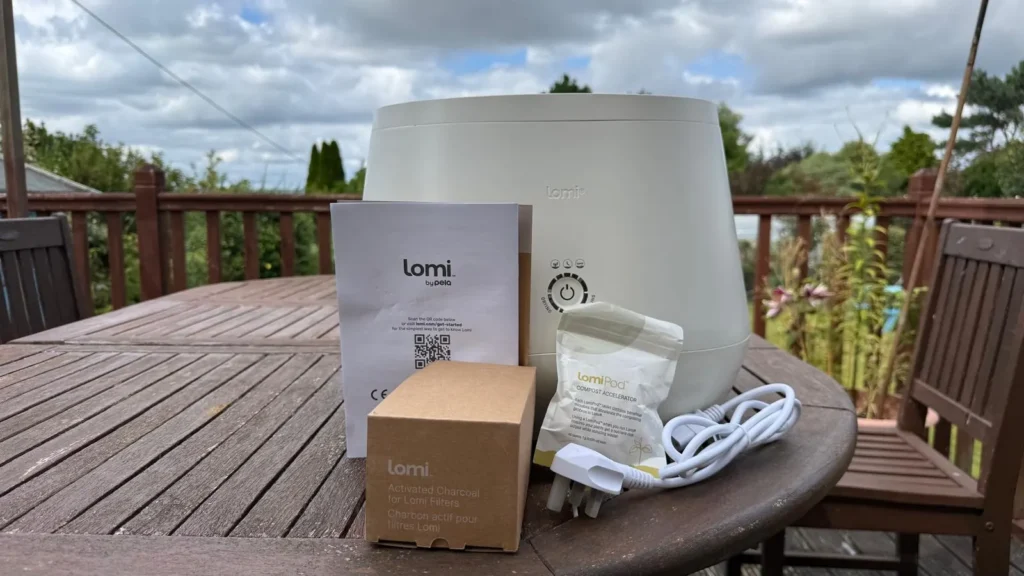
Until now, we’ve reviewed only microbial composters. The Lomi (pictured above) is different, as it grinds and dehydrates food waste rather than composting it. It is now on our counter for testing as, well, that might all some people want!
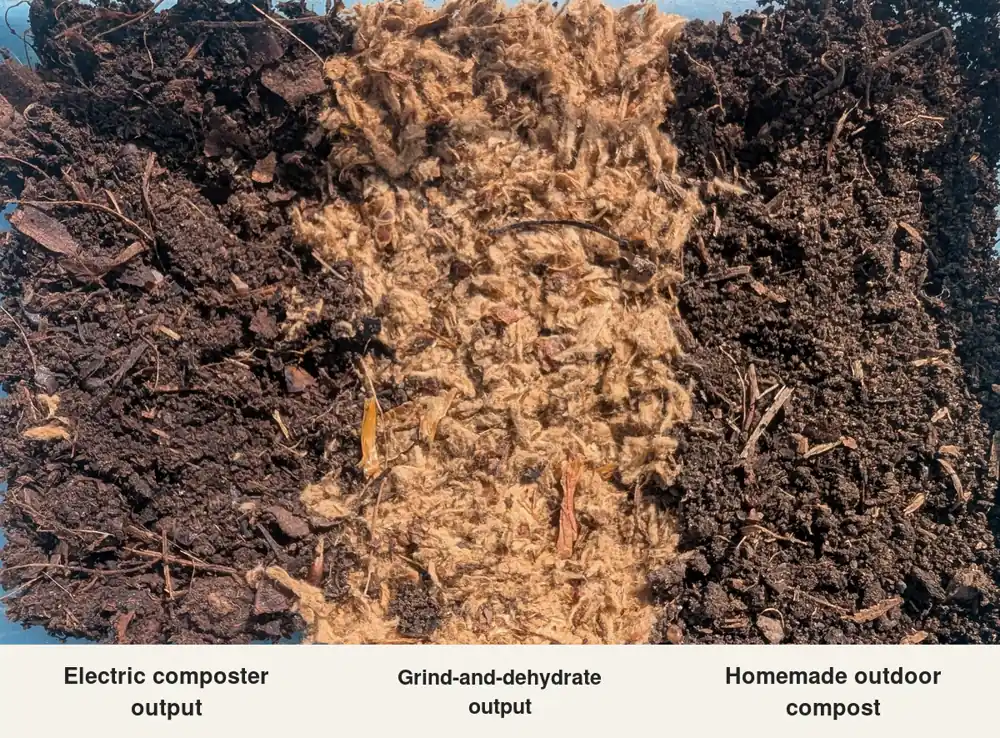
Our early impressions are mixed. We like its appearance and compact size, but find the lid awkward to screw on and off. The finished material looks more like sawdust than compost – which is to be expected from a dehydrator, but is worth knowing if you are expecting finished compost.
We have also asked Lomi how its pods work. At the time of writing, five days later, we had yet to receive a response.
Electric composter FAQs
Which is the easiest electric composter to open and close?
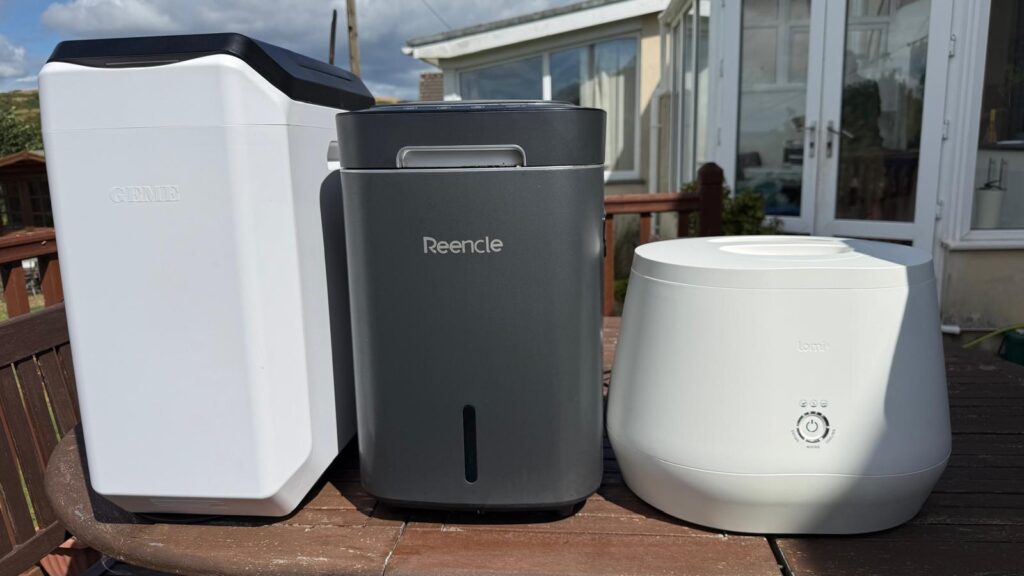
The GEME Terra II was the easiest for us, opening with a button or a press of the foot. The Reencle was also easy. We tended to open it with a wave of the hand (it can also be used with a button), but we kept opening it by accident when we walked past, which we didn’t have with the GEME. On balance, we preferred the GEME Terra II.
The Lomi was the most awkward of the three to open. You need to manually twist and remove the lid, and we found replacing it could be quite fiddly. (Siska was better at this than me, but we both find it awkward at times.)
Which is the most compact?
The Lomi is the most compact of the electric composters we have trialled so far, making it the most suitable for a compact kitchen. I also really like the fact that you can remove the bucket and place it beside you while cooking.
Which is best for capacity?
The GEME Terra II handles the most waste. Its chamber is similar in size to the Reencle’s, but it processes waste faster, so it can handle a lot more. The Lomi’s capacity feels quite small after the other two. However, because the Lomi dehydrates waste rather than composting it, you can empty it more regularly.
Which is the quietest electric composter?
During testing, we found the Reencle to be the quietest of the three. (When we tested the Reencle, we hadn’t yet introduced sound testing, but it is commonly reported at 28–30 decibels.) We measured the GEME Terra II at 50.3 decibels, closer to a quiet fridge hum. (GEME claims 35 to 40, so our reading came in a little higher.) The Lomi was the loudest at 64.8 decibels, measured during the grinding phase of its Eco-Express mode, about the level of normal conversation. We’ll update these figures as we test.
How do bio-waste electric composters work?
Traditionally, electric composters worked by grinding and dehydrating waste. The resulting material could be composted or even added to the soil – but it’s not living compost.
Actual composting requires bacteria to turn waste into an organic material. The fastest – and least smelly – bacteria are aerobic (which literally means ‘with air’).
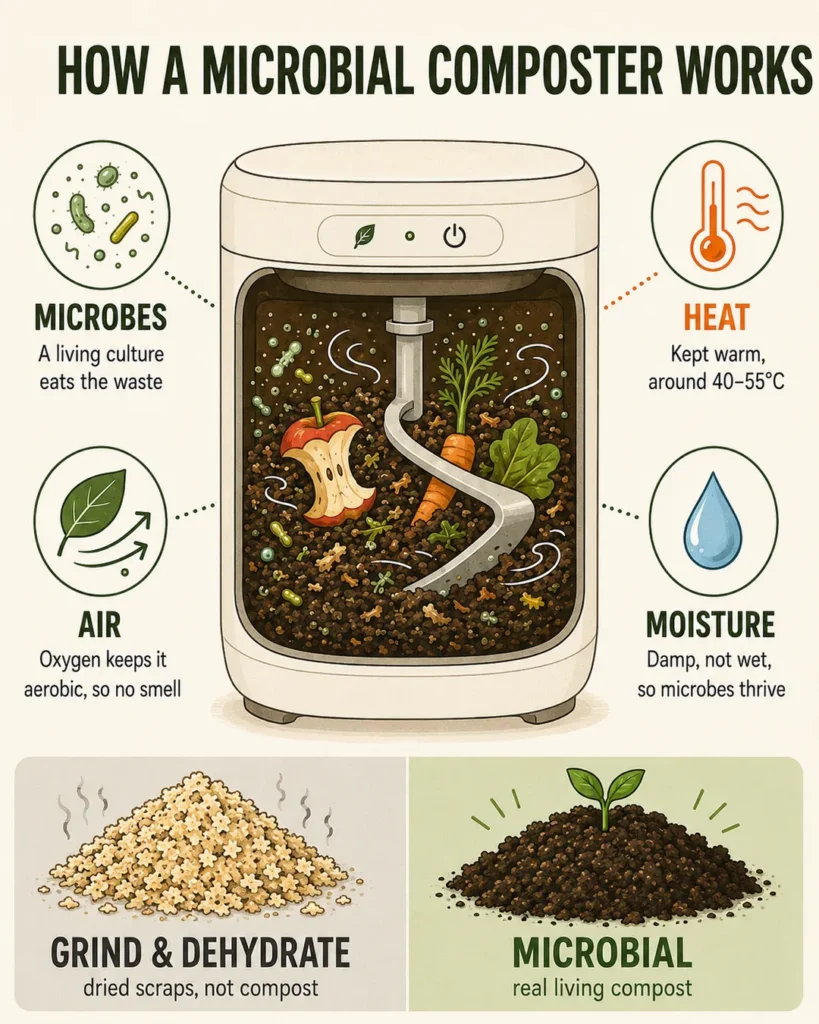
These bacteria need warmth, oxygen and the right level of moisture in order to break down material. Electric composters work by recreating this ideal scenario. Learn more: How electric composters work.
Is an electric composter right for you?
Let’s get one thing clear – you don’t need an electric composter to make compost. If you have a garden, you can use outdoor compost bins or even trench composting to create large amounts of compost at low cost. If you don’t have a garden, you can use worm bins or cardboard box composting to compost inside.
Some electric composters claim to be environmentally friendly. The idea here is that the waste doesn’t go into landfill where it produces methane but is instead turned into compost. However, these devices do use electricity – about 1-1.5kWh per day. Unless you have a renewable source of energy, it is hard to see how these can have a net benefit for the environment.
The real benefit of these devices is that they can quickly and efficiently get rid of kitchen waste – without it having to wait up to a week in a box to be picked up. The compost it makes is a real side benefit, and while it won’t be enough to feed a proper garden, I was pleasantly surprised with the amount of compost produced.
Learn more: Are electric composters worth it?
The reviewers

Apart from an interlude abroad, when he was stuck in a high rise flat, James has been gardening since the tender age of 7 (which is more years than he cares to admit). He’s composted seriously since 2010, building or using more than 35 composting systems along the way. Since 2018 he has been writing about composting, covering everything from the studies that help inform better composting practices to in-depth
Siska is an accomplished cook who used to own a food business. When she’s not cooking for a hundred people at a time, she’s putting kitchen compost bins through their paces. While James is interested in the science behind them and the compost they produce, Siska assesses bins both from their aesthetics and their practical usability in a busy kitchen.
James and Siska are the parents of two grown-up ‘kids’ and have been happily married since 2002.