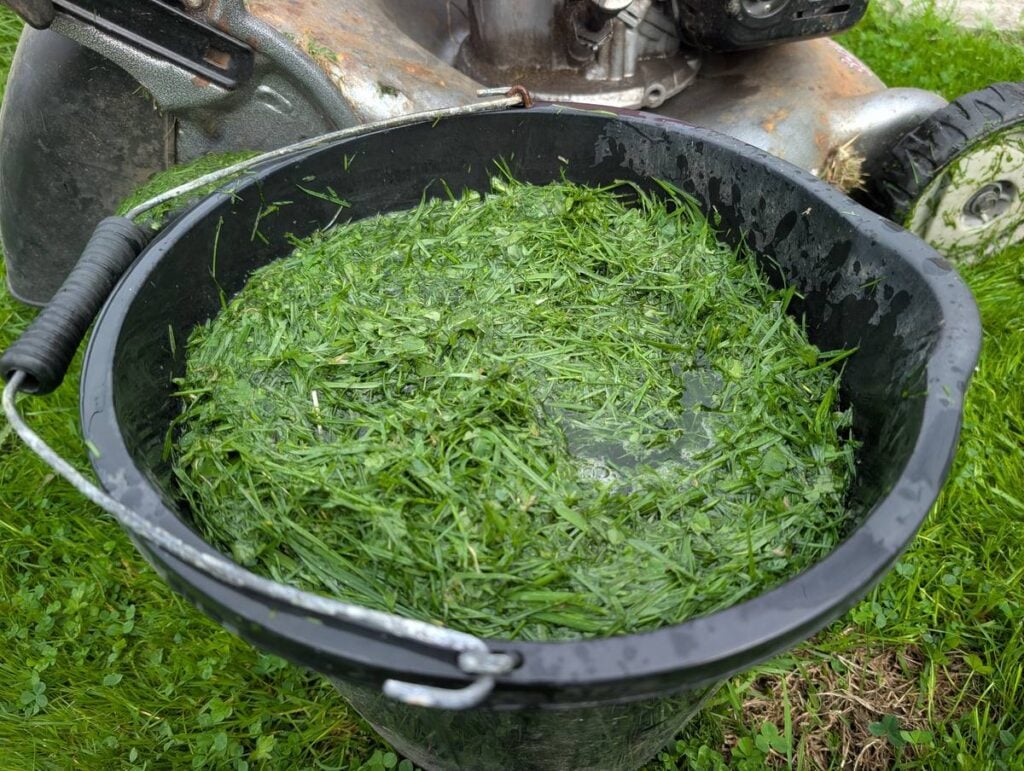
My wife and I have different ideas when it comes to the garden.
I see it primarily as a place to grow food and experiment with weird and wonderful combinations. That’s where the 26-foot-long polytunnel, the veg beds, the compost bins and heaps and the chicken run come from.
My wife likes the fresh food, but she primarily sees it as a place to enjoy – visually. So that’s where our pond, our arch and flowers come from.
It’s also why we have a large expanse of lawn – part of the garden which my wife sees as visually appealing and I used to see as a vast waste of space.
So, in the interest of not wasting the grass (or the rich clover that grows amongst it), I’ve experimented with many uses over the years. I’ve gotten to the stage where I don’t use just my own grass – I eagerly gobble up grass clippings from my neighbours too (except when they annoyingly start following my example and using it themselves!)
I’ve used many of the methods here, but in the interests of being thorough, I’ve researched even more for this article. My favourite use, though, is saved until last.
Warnings
First things first, though. All this assumes you don’t use herbicides. The wrong herbicide can cause damage to your plants, and once cost me a season’s growing from a large raised bed.
If you do use herbicide, consider whether you need to. Legumes in grass help fertilise it, while wild flowers that naturally occur can provide a rich source of food for insects.
1. Use it as a mulch
I’ve typically said I don’t mulch because of my wet, wet climate. The one time I did try it, many years ago, it became a slimy mess full of slugs.
But things changed this year. We had the driest summer I’ve ever known, and watering my large vegetable garden sometimes felt like a losing battle.
So I borrowed a technique from drier climates and mulched. Not with green grass, mind – I predominantly used dried grass and straw around my squash, courgettes (that’s zucchini for you Americans) and in the asparagus bed.
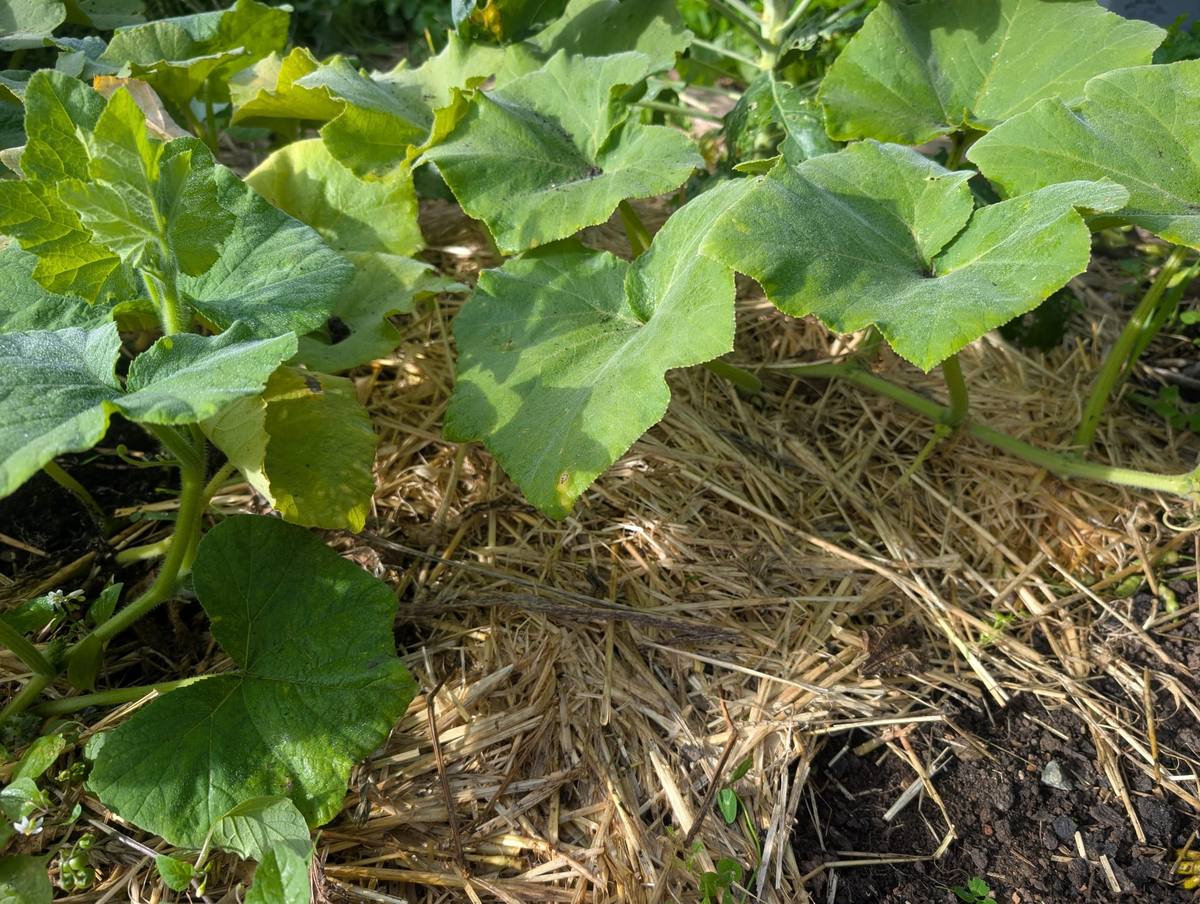
I placed it around the plants, leaving a little space around the stem. When I wanted to water, I’d poke the hosepipe through the dried grass and give it a good soaking.
The difference was particularly noticeable with my courgettes, which went from producing nothing back to their usual manic overachieving crop production.
2. Dry it and use it as a balanced composting material
As autumn falls (or fall falls for you US readers!) and trees shed their leaves, there always seems to be an abundance of browns for use in the compost heap.
But in spring and summer I have the opposite problem, and it can be hard to find enough browns to balance out all the green material you are using.
Freshly cut grass is wet and full of nitrogen – and if you don’t have the right amount of dry, brown material, it can be challenging to compost.
One solution is to dry the grass by laying it out in the sun. This dries the grass, and raises the C:N ratio to create a more balanced ratio of around 22:1 (based on hay, see Notes) [1].
Don’t layer it too thick, though, or you’ll find it is only dry on the top, with the bottom layer still wet and green.
3. Dry it and use it as animal bedding – with cautions
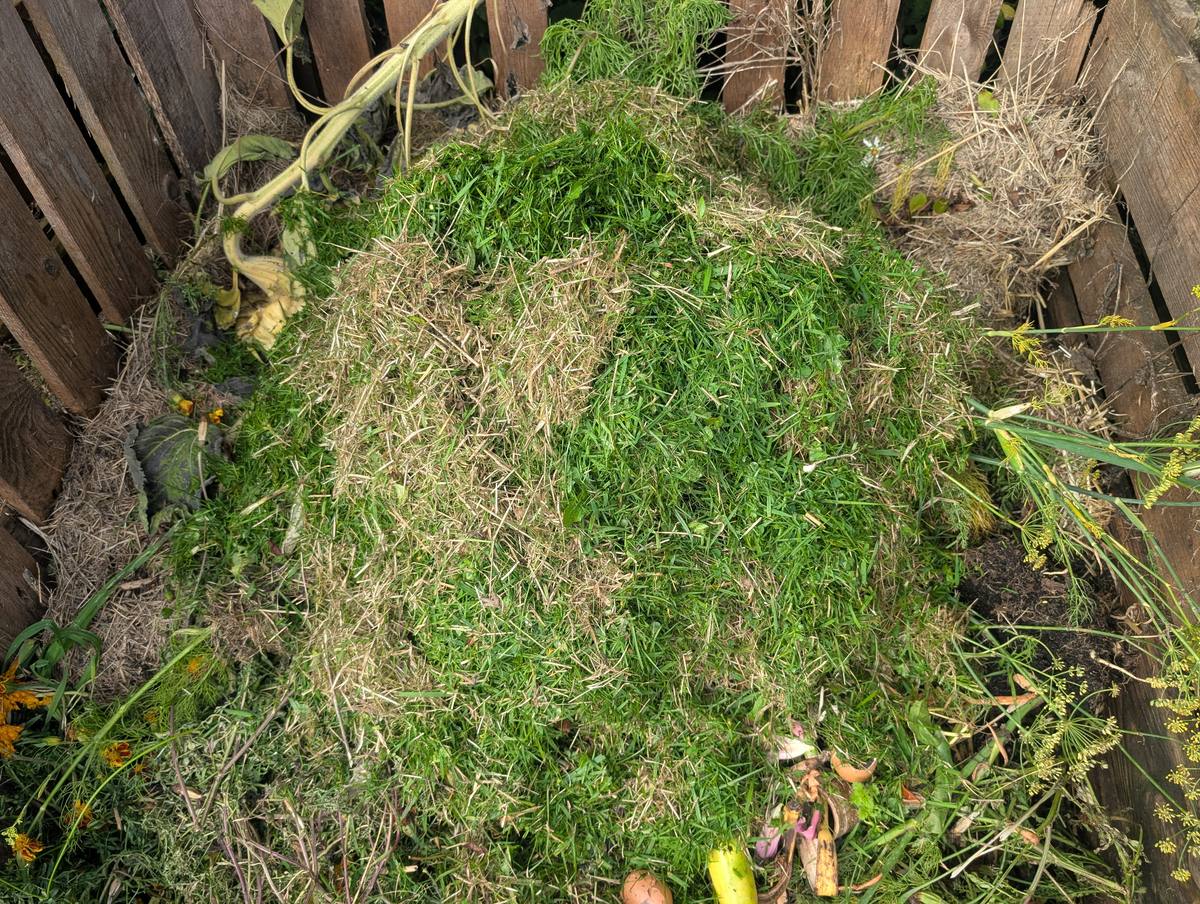
Dry grass clippings and use them as animal bedding for small animals. I’ve done this before for chickens, but you can also do it for small animals like rabbits and guinea pigs.
The key really is to dry it – otherwise it can have all its normal problems like compacting, matting and even getting too hot. Green grass clippings can also cause problems for some animals, such as rabbits and guinea pigs, as the grass rapidly ferments [3]. This can upset their stomachs if they nibble their bedding [4][5].
(Horse owners probably already know, but it bears repeating – never give grass clippings to horses, as they can cause colic [6].)
Of course, once it’s done its job and your animals have done their job, you can add it straight to the heap, where the manure will help it break down faster.
4. Make fertiliser
Making grass fertiliser couldn’t be easier – simply cover with water and leave for 3 days or so. Then strain and apply.
I’m going to add the one below to my squash plant, which, after sulking through a long, dry summer, has finally decided to start producing, and my hardy kiwis. You can leave it for longer to make a more concentrated mix.
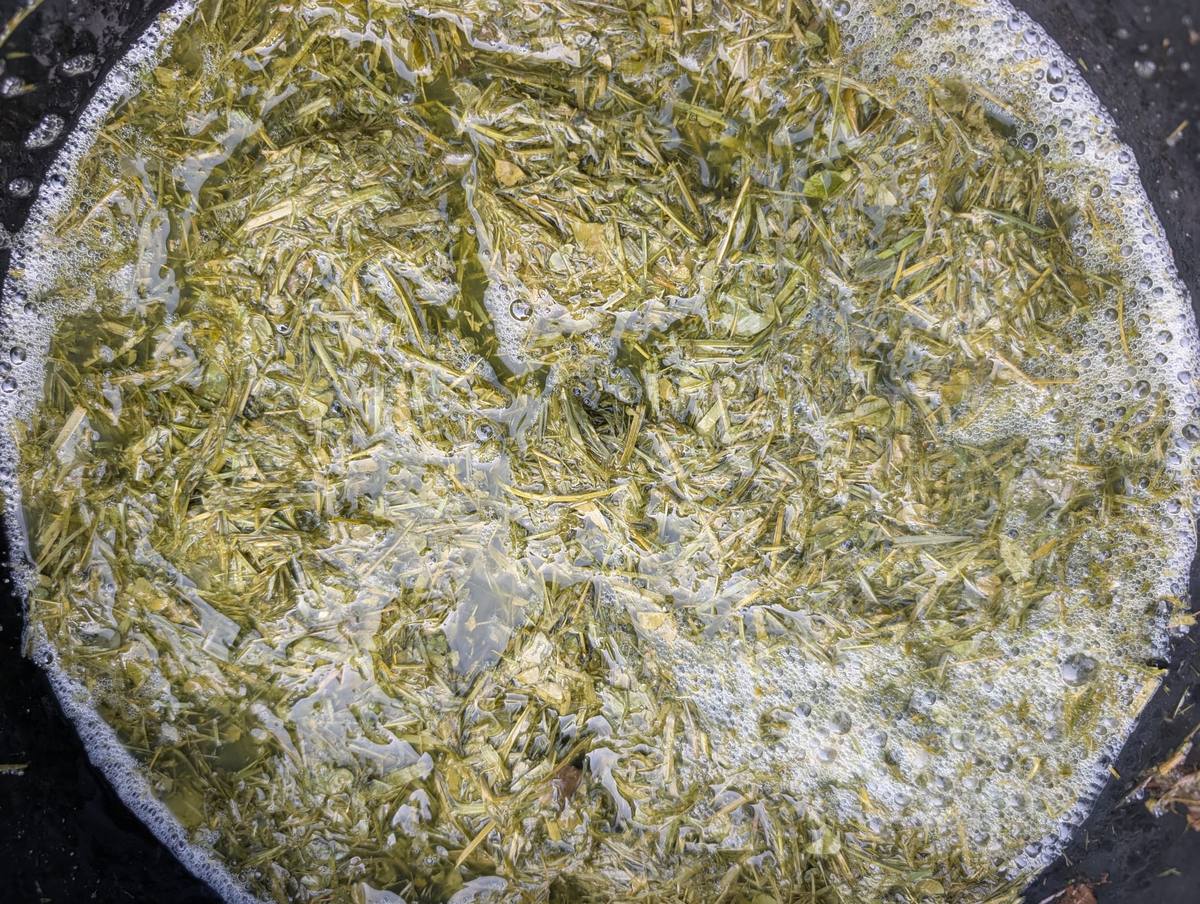
Many sources warn that this can smell really bad. It could be worse if you do this in the summer, but making it in autumn, I found that it really wasn’t too bad – and certainly not nearly as foul as homemade nettle fertiliser.
5. Use it as a compost accelerator
Being small and high in nitrogen, grass clippings are one of the most reliable ways to speed up a compost heap.
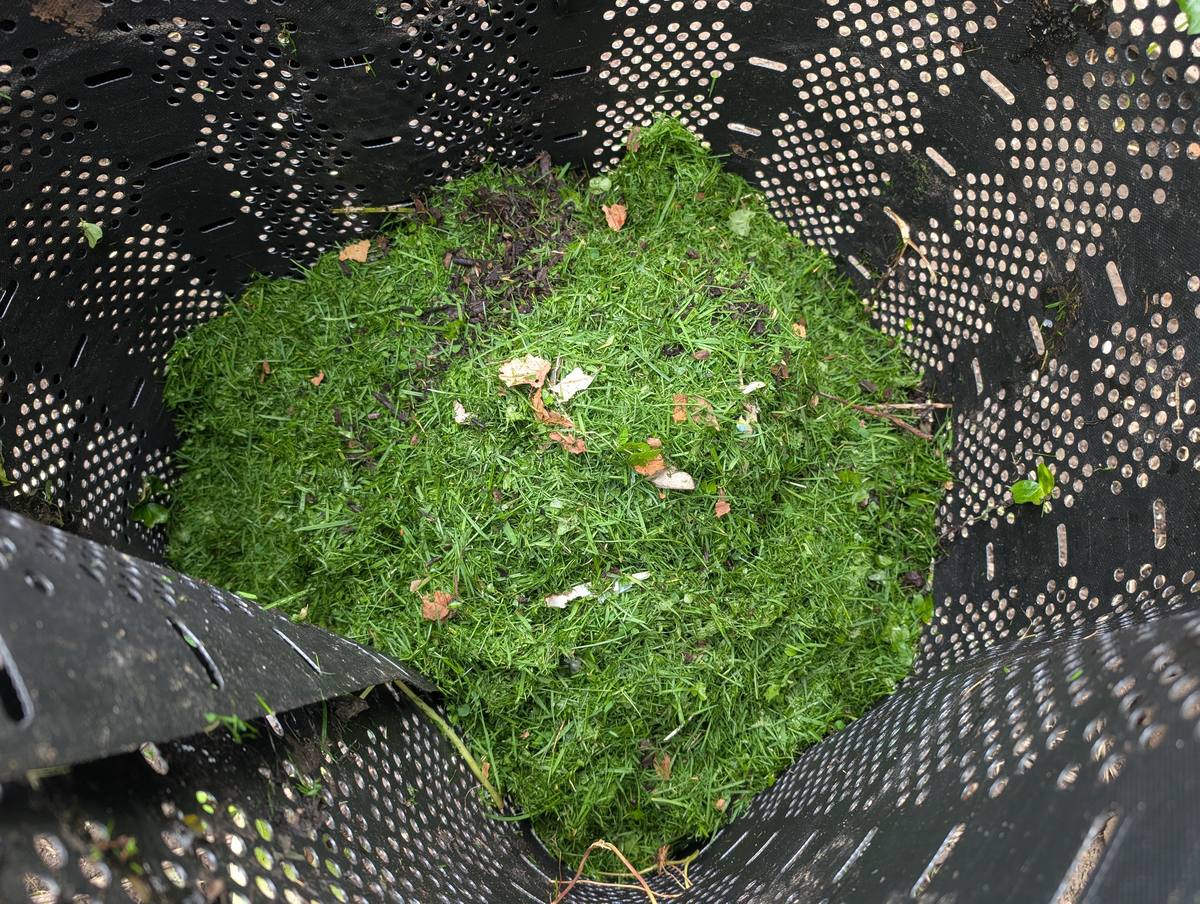
Just be careful to mix them in or use them in thin layers, or you’ll end up with a wet, matted mess.
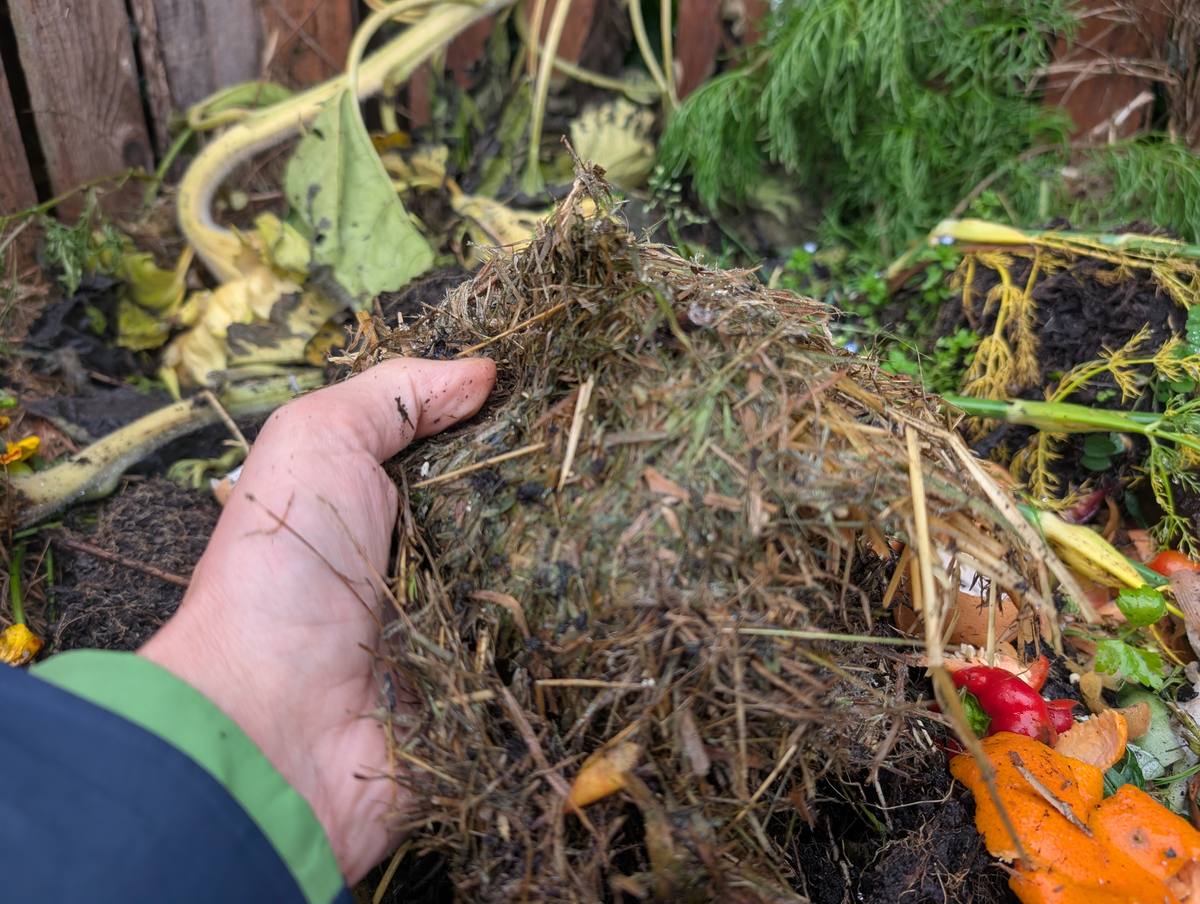
Learn more: How to compost grass clippings
6. Use it to rot autumn leaves down faster
Leaves make incredible compost – the only problem is that they can take a long time to rot down. However, if you mix them with grass clippings you can speed up the process considerably.
To really speed up the process, try spreading the leaves on the lawn and then mowing them up with your lawnmower. The combination of small leaf size and shredded high-nitrogen grass can really speed things up.
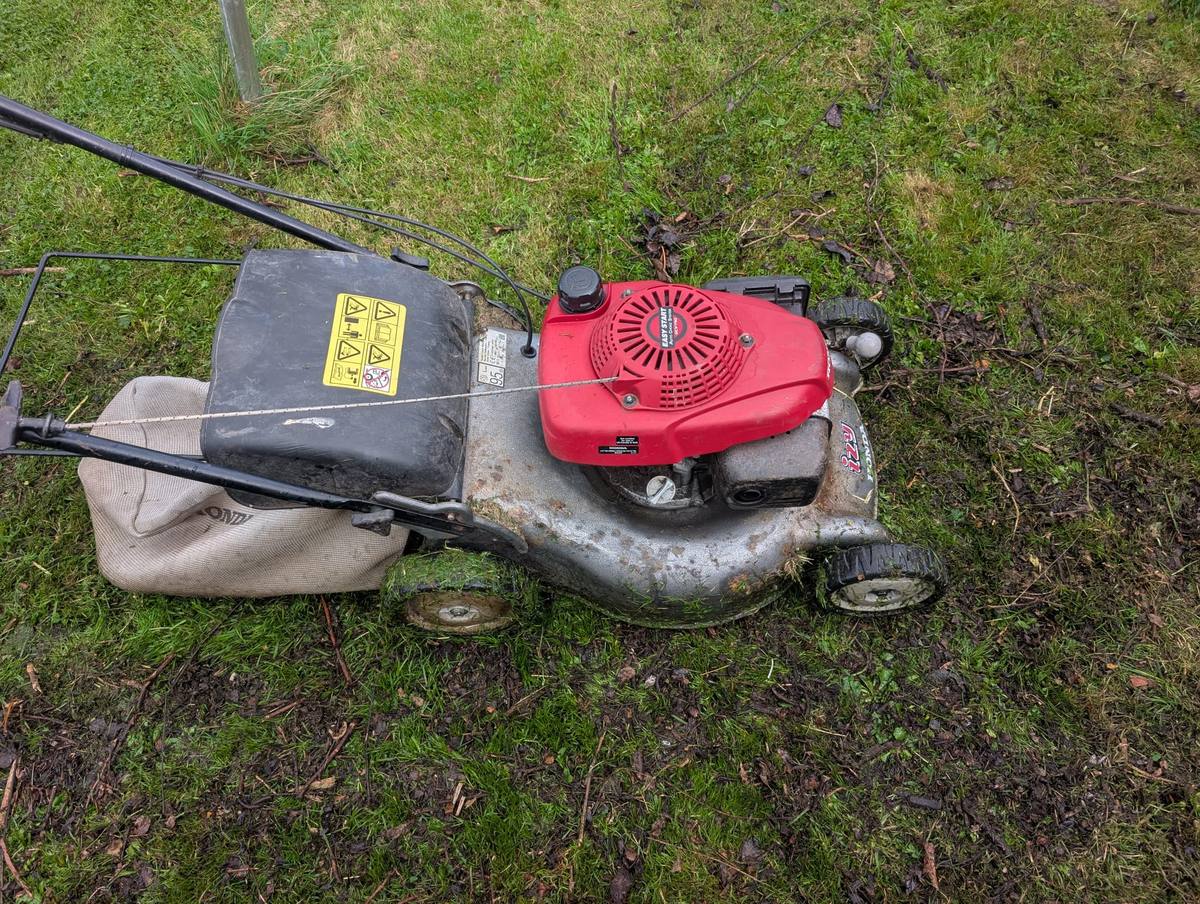
Learn more: How to make leaf mulch
7. Leave it on the lawn
If you want a rich, lush green lawn, why not just leave the clippings where they are? The grass clippings will slowly break down, releasing nutrients into the ground and feeding future growth [7]. Maybe not quite as nature intended, but not far off!
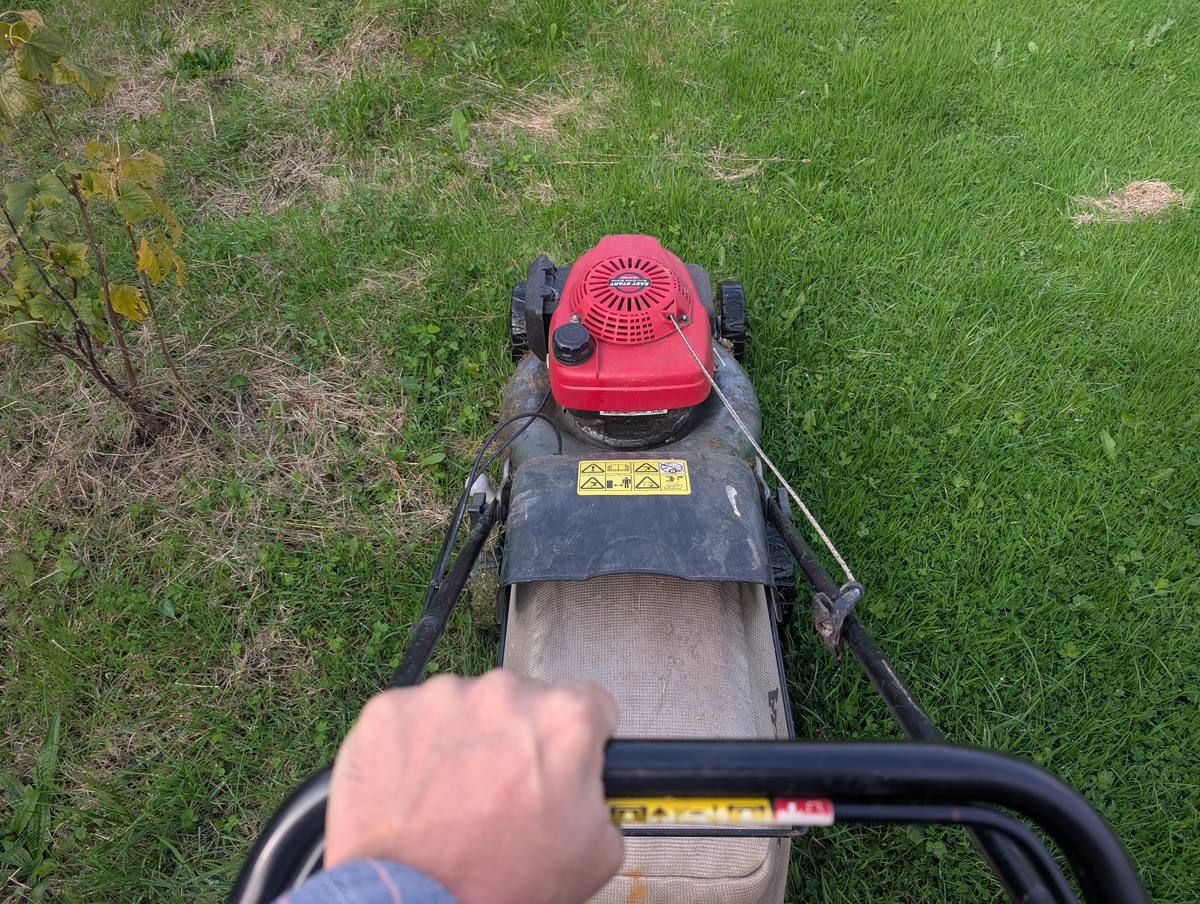
(Note that this works best if you mow little and often, so the clippings are short enough to drop down between the blades. Long clumps left lying on top could smother and yellow the grass underneath.)
8. Compost it
Being the editor of Compost Magazine, it probably doesn’t surprise you that my favourite thing to do with grass, even green grass, is to compost it.
In fact, grass is both a boon to composting and a challenge too. Get the compost mix wrong and grass can compact and/or get too hot, leaving an ashy residue behind. Get it right, and it’s the perfect ingredient for compost heaps, rapidly bringing even older heaps up to the perfect heat.
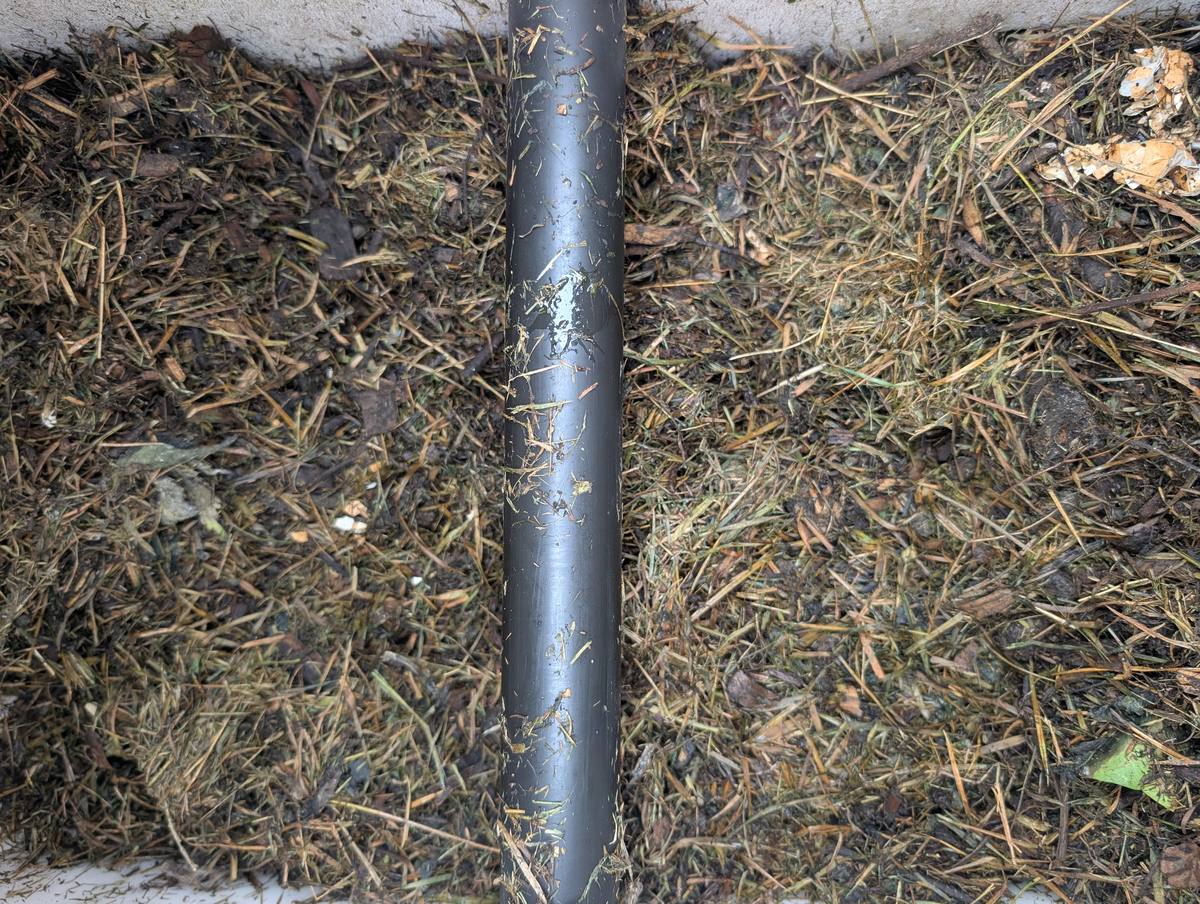
For my own tips and tricks on composting – based on years of experience (and plenty of mistakes along the way) see my guide to composting grass clippings
Notes
What is the carbon:nitrogen ratio in dried grass clippings?
We’ve been unable to find an exact C:N ratio for dried grass clippings. Sources typically give ranges between 9:1 and 25:1 for grass clippings [1][2], with an average of 17:1 [1]. For this post, we’re assuming dried clippings are more similar to dried hay, which has a C:N ratio of 22:1 [1].
Related articles
- Composting Grass Clippings: Mistakes, Myths and 2 Tricks
- Carbon to Nitrogen Ratio: The Key to Fast, Healthy Compost
- Compost C:N Ratio Calculator & Comprehensive Material Tables
- Herbicide Contamination in Compost: Risks, Research, Solutions
- Leaf Mold Magic: How to Use Fallen Leaves to Improve Your Garden Soil
- Compost Activators: Do They Work? (Plus 6 Free Alternatives You Can Use)
- Using Manure in Compost: How to Turn S**t Into Black Gold
Sources
[1] Rynk, R. (Ed.). (1992). On-Farm Composting Handbook (NRAES-54). Northeast Regional Agricultural Engineering Service.
[2] Cornell Waste Management Institute. (1996). Compost chemistry. Cornell Composting. https://www.css.cornell.edu/cwmi/compost/chemistry.html
[3] Royal Veterinary College Exotics Service. (n.d.). Rabbit care. https://www.rvc.ac.uk/Media/Default/Beaumont%20Sainsbury%20Animal%20Hospital/documents/caring-for-and-feeding-your-rabbit.pdf
[4] Scottish Government. (2018). Pet rabbit welfare guidance: The need for a suitable diet. https://www.gov.scot/publications/pet-rabbit-welfare-guidance/pages/5/
[5] RSPCA Australia. (2019). How should I care for my guinea pig? https://www.rspca.org.au/latest-news/blog/how-should-i-care-my-guinea-pig/
[6] The British Horse Society. (n.d.). Grass cuttings and garden waste. https://bhs.org.uk/support-us/our-campaigns/be-horse-aware/grass-cuttings
[7] Kopp, K. L., & Guillard, K. (2002). Clipping Management and Nitrogen Fertilization of Turfgrass: Growth, Nitrogen Utilization, and Quality. Crop Science, 42(4), 1225-1231. https://doi.org/10.2135/cropsci2002.1225