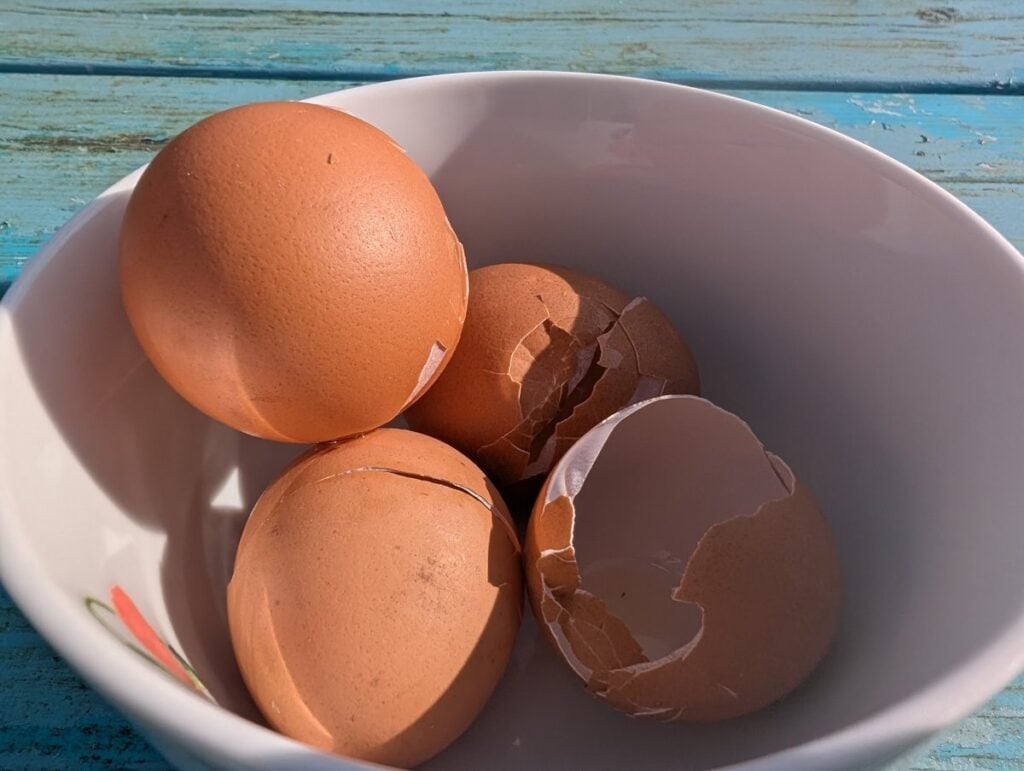
With a flock of chickens in our garden, my family eats more than our fair share of eggs.
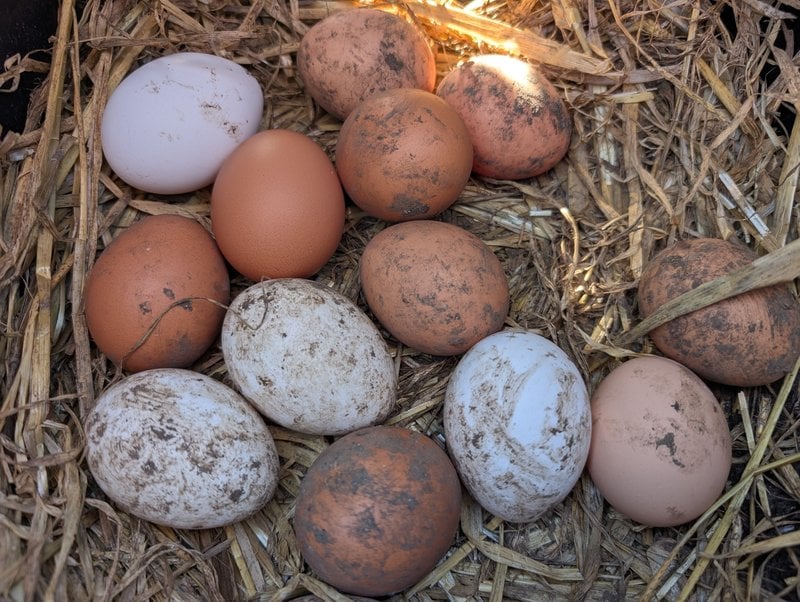
That leaves us with plenty of eggshells to dispose of.
I crush some of the shells and give them back to the chickens for a source of calcium, but the chickens don’t eat all of them.
The other option, of course, is composting.
However, many guides to composting eggshells lay out time-consuming instructions.
That’s fine if you have the enthusiasm, but for most of us, composting needs to be quick and easy if we are going to maintain it for the long term.
But before we look at the challenge of dealing with eggshells, let’s look at how they might benefit your soil and compost.
Eggshells are rich in calcium
Several studies have tested composting eggshells mixed with organic matter such as straw and chicken manure [1, 2].
They found that eggshells can make up to 30% of the compost mixture and still reach the thermophilic (hot) temperatures needed for rapid breakdown of compost material.
The resulting compost was particularly rich in calcium, making it ideal for use in calcium-poor soils.
Encouragingly, the compost made with eggshells produced excellent germination rates when tested with seeds.
But does the calcium in eggshells make it to the soil, in sufficient quantities, and if so, does it matter?
That’s less clear-cut.
The problem with eggshells

The problem lies in the composition of eggshells.
Eggshells are made of calcium carbonate. This is a tough material which can take a long time to break down.
In my experience, eggshells that haven’t been crushed up can still be left at the end of the composting process.
That’s backed up by an informal Garden Myths experiment that found eggshells were still intact five years after burying them in the soil!
As we’ve seen, studies have shown eggshells can be composted. However, these studies looked at hot composting, with temperatures reaching at least 50 °C (122°F).
Unfortunately, not all home composters reach those temperatures.
Because eggshells are resistant to breakdown, keen gardeners suggest a number of different ways you can tackle them before adding them to the compost heap:
- Crushing
You can crush egg shells with a pestle and mortar before adding them to the compost heap.
This is probably the least time consuming, but as the fragments are larger, also likely to be less effective. It works best if you pre-cook the shells so the eggs are dry and brittle.
- Grinding
Pre-cook the eggshells in the oven at 220F to dry them out. Using a tool such as a coffee grinder, grind them into a fine powder.
This is likely to be more effective than crushing egg shells: studies have shown that when eggshells are crushed into powder and applied to soil, it can increase calcium uptake, neutralize soil acidity and increase plant growth [3].
- Mix with vinegar
In this process egg shells are usually toasted, and then soaked in a white vinegar for a week. This causes a chemical reaction that releases the calcium into a form plants can use. This is more usually done to prepare a plant feed, but could theoretically be done before adding to the compost.
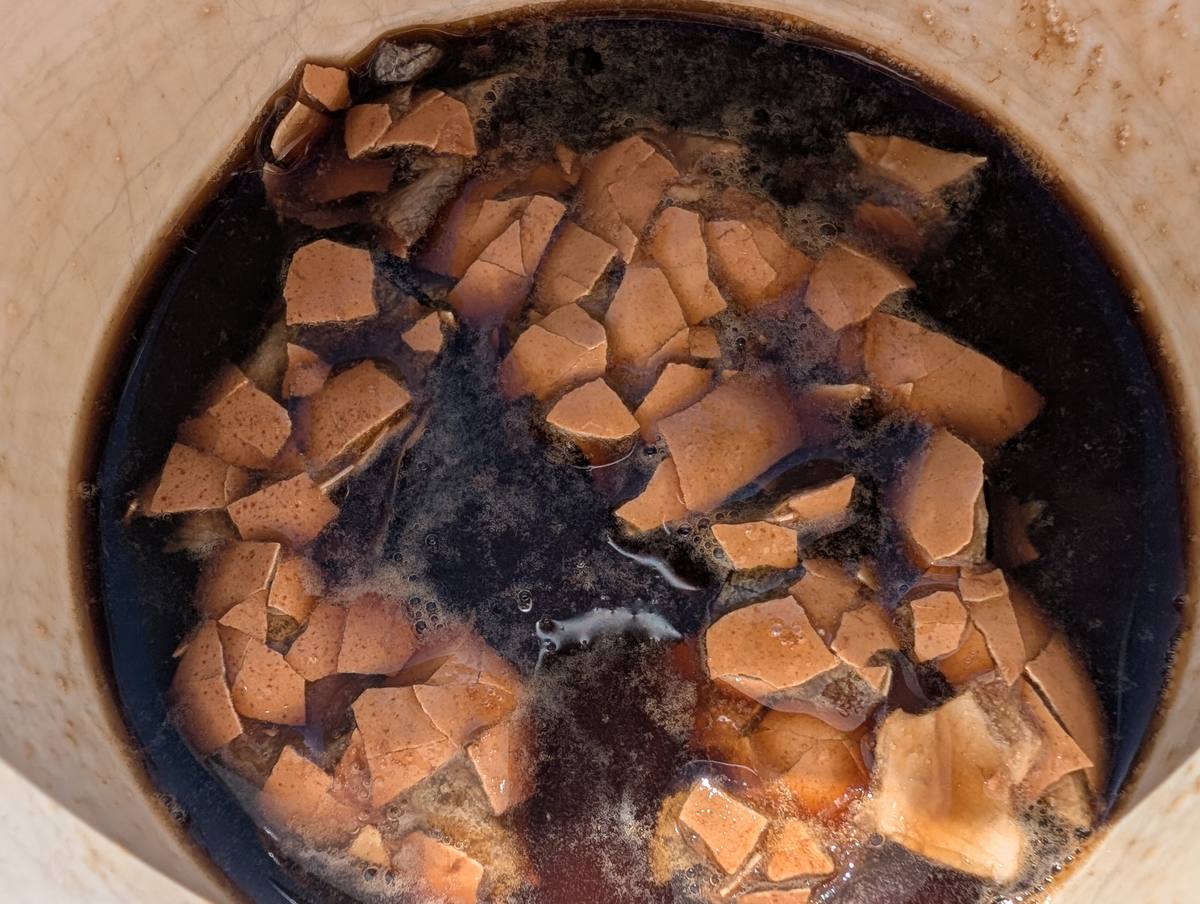
The problem with all of these is the lack of efficiency.
For most of us, eggshells make up a very small amount of our compost materials.
In my ¼ acre garden, for example, I process several tonnes of compost material a year, especially when I take deliveries of a trailer load of manure.
The extra time taken to prepare a handful of eggshells every week doesn’t seem to be worth it.
The need to pre-cook egg shells or add vinegar leads to additional costs and energy use which is disproportionate to the amount of compost you can make.
The easy way to compost egg shells
Fortunately, you can reduce the size of eggshells without taking an age to prepare them.
All I do is simply grab the eggshells, crush them in my hand and add them to the kitchen
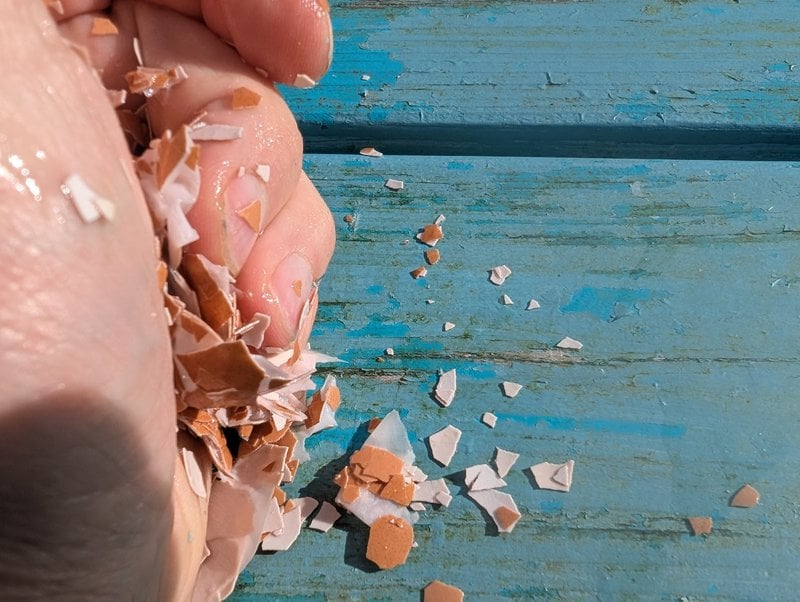
While this is not as effective as grinding them into a powder, it literally takes seconds.
When possible, I add them to a hot compost heap, where the heat should make the eggshells brittle, accelerating the breakdown.
(When I don’t have a hot compost heap, I simply accept that the breakdown process will take a long time!)
As with all composting materials, it’s important to ensure that the eggs shells are mixed in with a good mixture of brown (high carbon) and green (high nitrogen) material.
You can check your mix of materials with our Carbon:Nitrogen ratio calculator.
Is there a danger of salmonella from using eggshells in compost?
Eggshells can harbor salmonella.
Boiling water kills salmonella, so if you’re using the shells from boiled eggs it’s not something to worry about.
I’m not convinced you need to worry anyway.
If you’re hot composting, the hot temperatures are likely to kill the salmonella bugs.
Indeed, the studies referenced below found that eggshell compost was perfectly acceptable for agricultural use, despite the potential presence of salmonella pre-composting [1, 2].
Even cold composting is good at killing pathogens as long as you allow the compost enough time to mature.
However, if you are worried, ensure you wash the eggshells before composting them. (As you can imagine, this is more easily done before you crack them open!)
Let’s not over-egg the benefits
It’s true that calcium matters to plants, and it’s often recommended to prevent particular problems, such as blossom-end rot in tomatoes. However, the RHS says it is very rare for soils to lack calcium. The real problem is usually irregular watering, which stops calcium already in the soil from reaching the fruit.
Even if your soil is short of calcium and you do grind your eggshells up into small pieces, the quantity added to compost is not likely to make much of a difference.
(And that’s even assuming they will break down in the composting process.)
Eggshells do seem to be more useful on acidic soil, with trials suggesting they work as a slow-acting garden lime [3, 4]. However, you would need a lot of them. Even the lowest rate in an Iowa State University field trial came to around 40 to 50 eggshells per square meter (about four per square foot) [4].
If you’re short of time but still want to reduce waste, just crush them up in your hand, add them to your compost pile and let nature take its course.
It probably won’t have much impact, but at least it’s one less thing to throw in the trash.
Read more
- Does Lime Really Speed Up Compost?
- Ash in Compost: 6 Powerful Benefits (and How to Use It Right!)
- 5 Rules for Successful Hot Composting (Daily Turning Not Included!)
- The Pathogen-Destroying Power of Composting
- What You (Really) Can’t Compost
- I Buried A Whole Chicken In My Compost Bin. This Is What It Looked Like Two Days Later
References
[1] Soares, M. A. R., Andrade, S. R., Martins, R. C., Quina, M. J., & Quinta-Ferreira, R. M. (2012). Organic biowastes blend selection for composting industrial eggshell by-product: Experimental and statistical mixture design. Water Science and Technology, 65(11), 1947-1953. https://doi.org/10.2166/wst.2012.090
[2] Quina, M. J., Soares, M. A. R., Ribeiro, A. A., Marques, A. P., Costa, I. H., & Magalhães, M. C. (2014). Feasibility Study on Windrow Co-composting to Recycle Industrial Eggshell Waste. Waste and Biomass Valorization, 5, 87-95. https://doi.org/10.1007/s12649-013-9211-5
[3] Vu, N.-T., Dinh, T.-H., Le, T.-T.-C., Vu, T.-T.-H., Nguyen, T.-T.-T., Pham, T.-A., Vu, N.-L., Koji, S., Hama, S., Kim, I.-S., Jang, D.-C., Kim, D.-H., & Tran, A.-T. (2022). Eggshell powder as calcium source on growth and yield of groundnut (Arachis hypogaea L.). Plant Production Science, 25(4), 413-420. https://doi.org/10.1080/1343943X.2022.2120506
[4] Holmes, J. D., Sawyer, J. E., Kassel, P., & Ruiz Diaz, D. (2011). Using Ground Eggshells as a Liming Material in Corn and Soybean Production. Crop Management. https://doi.org/10.1094/CM-2011-1129-01-RS