A manual on making saltpetre
Joseph LeConte was both a chemist and a multi-disciplinary scientist who was so fascinated by the natural sciences that he had abandoned a career in medicine to focus on them.
And at the request of the military, he wrote a pamphlet on how to make saltpetre [1].
LeConte, in the pamphlet, pointed out that saltpetre occurred:
“frequently under a concurrence of circumstances which, though not strictly natural, is at least accidental … in cellars, stables, manure-heaps…”
He believed some saltpetre could be harvested from existing manure and waste heaps. He also pointed out that it could be deliberately created under specific conditions:
“1st, the presence of decaying organic matter, animal or vegetable, especially the former; 2d, an alkaline or earthy base, as potash or lime; 3d, sufficient moisture; 4th, free exposure to the oxygen of the air; and 5th, shelter from sun and rain.”
LeConte was concerned that there might not be enough manure to produce the nitrate, and suggested creating “black earth” (compost) with vegetable and animal waste.
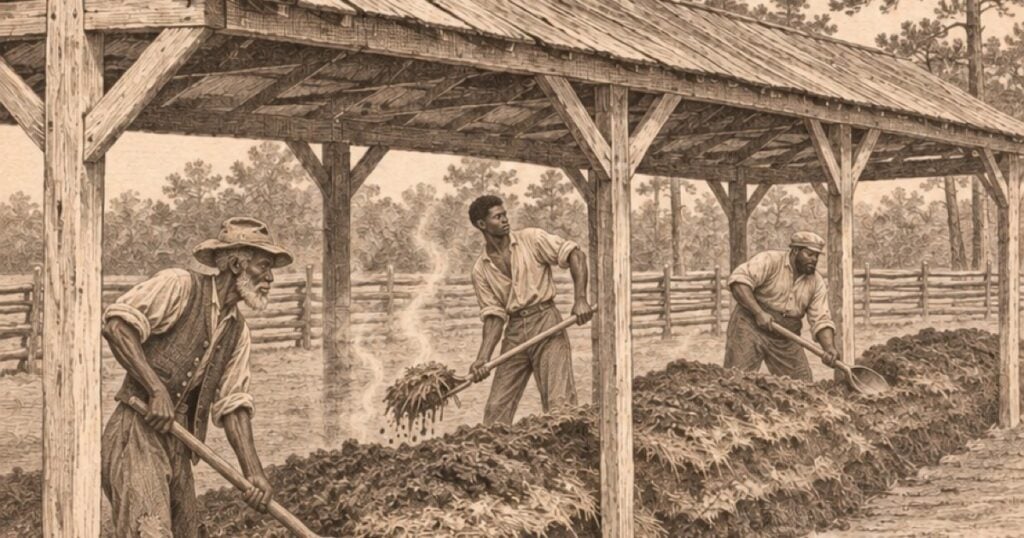
The actual methods he suggested for creating what he called nitre beds varied. And one of these was the French Method [1].
The French Method
1. A hard floor
The bed was started on a hard clay floor to stop anything precious leaking away into the ground.
2. Rotted manure
Animal waste was laid down first, “especially the former”. LeConte’s conditions put decaying animal matter ahead of vegetable waste.
3. Wood ash and old mortar
The alkaline base consisted of wood ash for potash and old lime mortar from demolished buildings for lime.
4. Leaves, straw and twigs
Bulky plant material was included to hold air in the heap.
5. A topping of soil
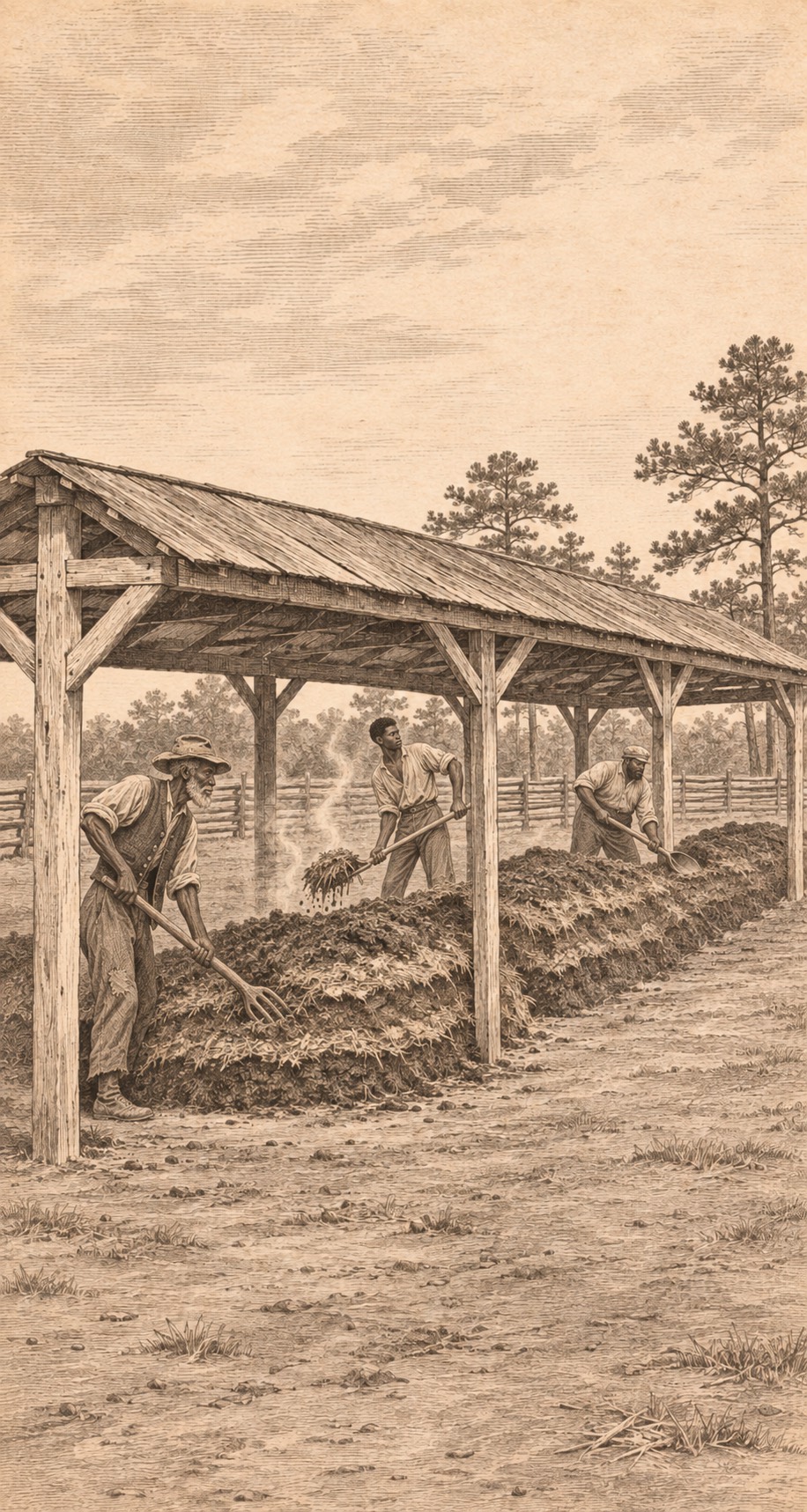
The result was a heap 4–5 ft high, 6–7 ft wide and 15 ft long.
6. A rough shed
Shelter from sun and rain was the fifth condition. Big sites ran rows of beds under one roof.
7. Watered every week
Urine, dung-water, privy and cesspool water kept it “always moist, but not wet”.
8. Turned, and turned again
The top 5–6 inches was turned every week, while the whole pile was turned every month.
The pile should be watered every week with urine, dung-water, privy and cesspool water, to keep it “always moist, but not wet”. The top 5-6 inches should be turned every week, with the whole pile turned every month.
The process was time-consuming, and LeConte himself warned that there was a possibility the war would be over before the nitrate could be used to make gunpowder.
However, LeConte reassured, the effort would not be wasted:
“The method of preparing and making saltpetre-beds is precisely the most approved method of making the best manure… ought to be annually undertaken by every planter… and would be amply rewarded in the increased production of field crops.” [1]
(A similar sentiment was echoed by modern compost scientists, showing that sometimes new research just brings back old knowledge.)
Did it actually help the Confederacy?
By the end of 1864, an estimated 2,800,000 cubic feet of ‘earth’ had been collected and was “in various stages of nitrification” [2]. It was estimated that would yield around one and a half pounds of nitrate per cubic foot.
According to the General in charge of the works, the piles had become quite valuable. Yet, other than for test purposes, the nitrate was never extracted [2]. As LeConte had feared, the Confederates had run out of time [3].
The story in dates
South Carolina’s Military Department has LeConte’s pamphlet printed in Columbia: 14 pages, for “planters and manufacturers”.
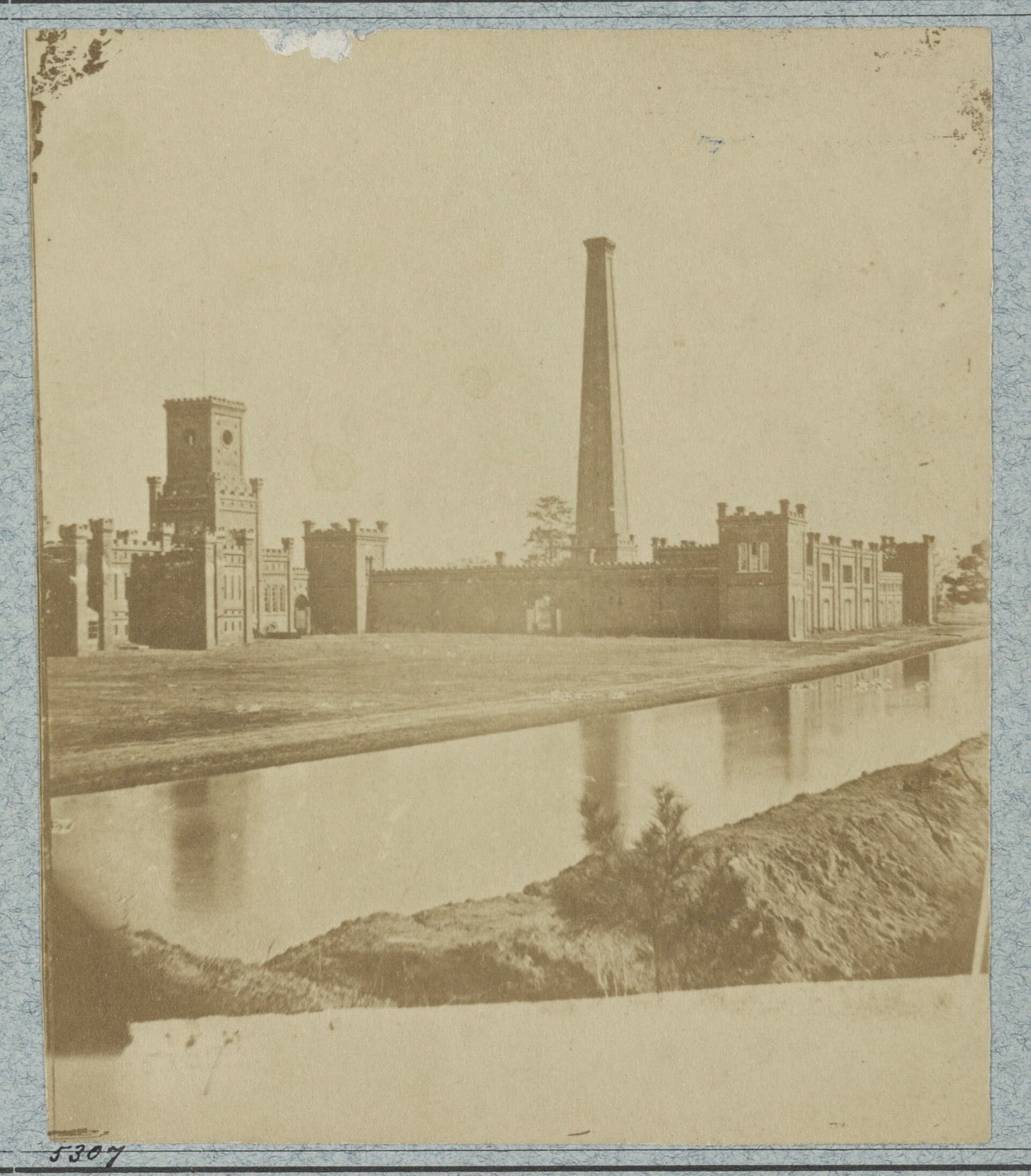
Chief of Ordnance Josiah Gorgas puts Col. Isaac St. John in charge of all nitre production, including beds already begun in Richmond.
Beds are dug at Columbia, Charleston, Savannah, Augusta, Mobile, Selma and other points.
LeConte joins the Nitre and Mining Bureau as its chemist, with the rank and pay of major.
2,800,000 cubic feet of earth are collected and in various stages of nitrification.
As Sherman approaches Columbia, LeConte leaves with Bureau stores and the families of those who had worked on the niter plantation.
The war ends. Other than for trial, nitre was never extracted from the beds.
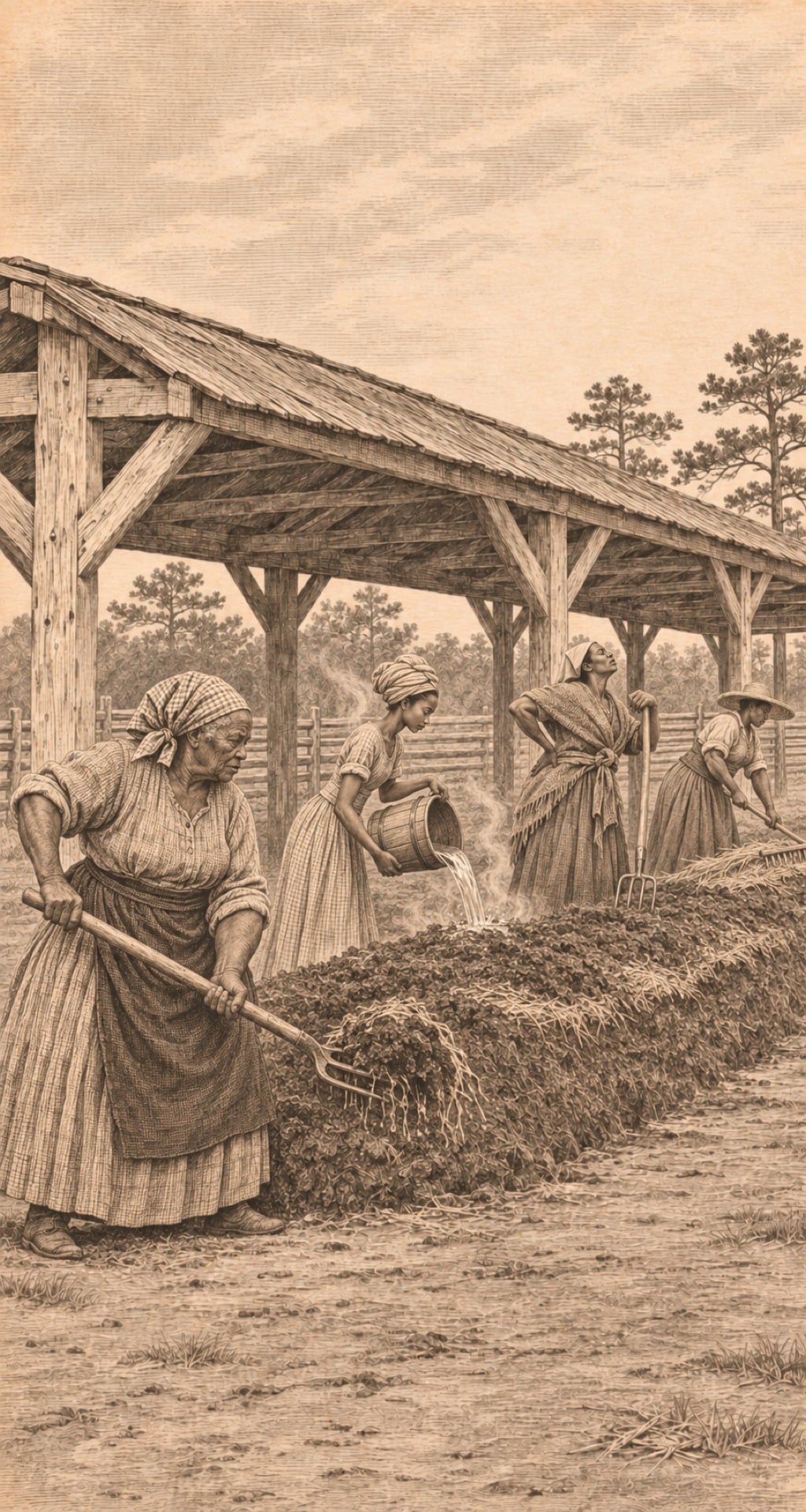
Who worked the beds?
- Peggy
- Becca
- Scilla
- Dinah
- Sibby
- Sarah
- Betsy
Seven of the workers named in the records of the Charleston Nitre Works in October 1863. These were enslaved people, leased to the government by their enslavers.
Why did it work?
In the 1860s LeConte knew that composting would work to make nitrate – but he didn’t know how it worked. It took later researchers to find that microbes create the nitrate [4].
And yes, nitrate will form in your garden compost heap too. However, in the case of hot heaps, this mostly forms after temperatures fall below 40°C [5]. Before that, nitrogen is concentrated in the form of ammonium.
Try it: cool a compost heap
What happened to LeConte?
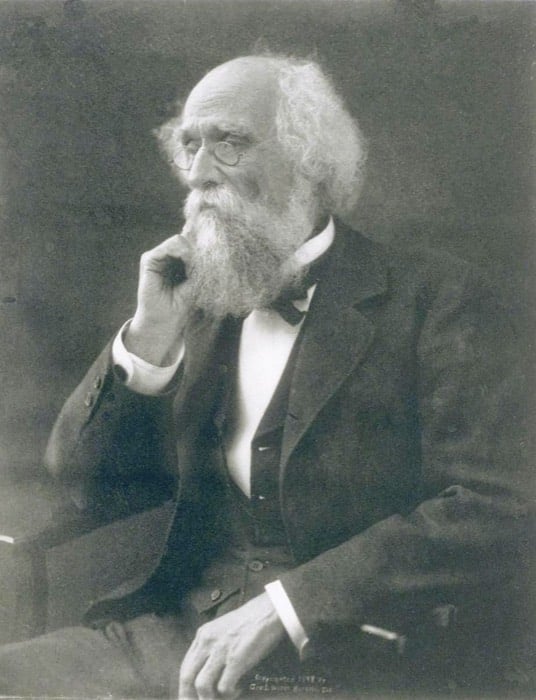
LeConte would later be hired as the very first Professor of Geology, Natural History, and Botany at the University of California at Berkeley [6], as well as writing a widely used US school textbook on geology [7].
He was also deeply involved in conservation, becoming an early member of the environmental organization Sierra Club and serving on its board of directors.
The scientist, who had been raised on a slave-owning plantation, analysed the problems of the South and blamed its problem on slavery, writing in 1892:
“Slavery had become an anomaly in the civilized world, and especially in the democratic republic like our own. …In short, southerners had not kept pace with the process of evolutionary development.” [6]
Despite these thoughts, LeConte remained a racist and a white supremacist. The Sierra Club he helped found later renamed LeConte Memorial Lodge the “Yosemite Conservation Heritage Center.” [6]
Sources
[1] LeConte, J. (1862). Instructions for the Manufacture of Saltpetre. Charles P. Pelham, State Printer. https://docsouth.unc.edu/imls/lecontesalt/leconte.html
[2] Gorgas, J. (1884). Notes on the Ordnance Department of the Confederate Government. Southern Historical Society Papers, 12, 76. http://www.perseus.tufts.edu/hopper/text?doc=Perseus%3Atext%3A2001.05.0269%3Achapter%3D15
[3] Rains, G. W. (1882). History of the Confederate Powder Works. https://gutenberg.org/cache/epub/24537/pg24537-images.html
[4] Sedlacek, C. J. (2020). It Takes a Village: Discovering and Isolating the Nitrifiers. Frontiers in Microbiology, 11, 1900. https://doi.org/10.3389/fmicb.2020.01900
[5] Sánchez-Monedero, M. A., Roig, A., Paredes, C., & Bernal, M. P. (2001). Nitrogen transformation during organic waste composting by the Rutgers system and its effects on pH, EC and maturity of the composting mixtures. Bioresource Technology, 78(3), 301-308. https://doi.org/10.1016/S0960-8524(01)00031-1
[6] Sierra Club. (n.d.). Dr. Joseph LeConte. https://www.sierraclub.org/yosemite-heritage-center/dr-joseph-leconte
[7] Joseph LeConte. (n.d.). In Wikipedia. https://en.wikipedia.org/wiki/Joseph_LeConte