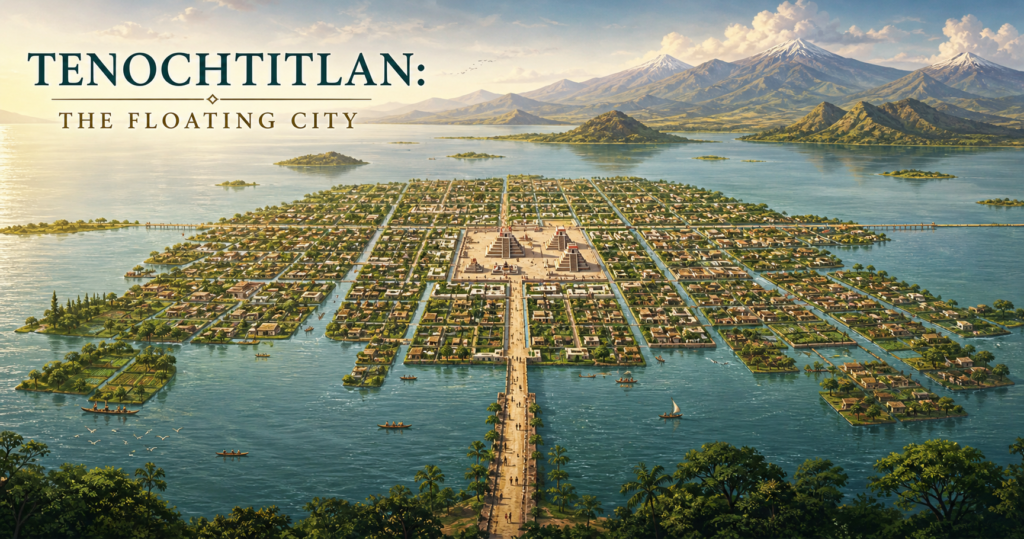
When the Spanish conquistador Bernal Díaz del Castillo walked into the great market at Tlatelolco in 1519, he was already struggling to find comparisons.
He’d seen the causeways stretching across the lake, aqueducts carrying fresh water into a city built on water, and soaring stone pyramids. Now, at the market, he listed what he saw: food stalls, jewellers, cloth merchants, herbalists.
And then something that stopped him.
Canoes moored along the canals, loaded with human excrement, being sold.
What Díaz had stumbled across wasn’t disorder. It was one of the most sophisticated nutrient recycling systems in the ancient world.
A city with a problem
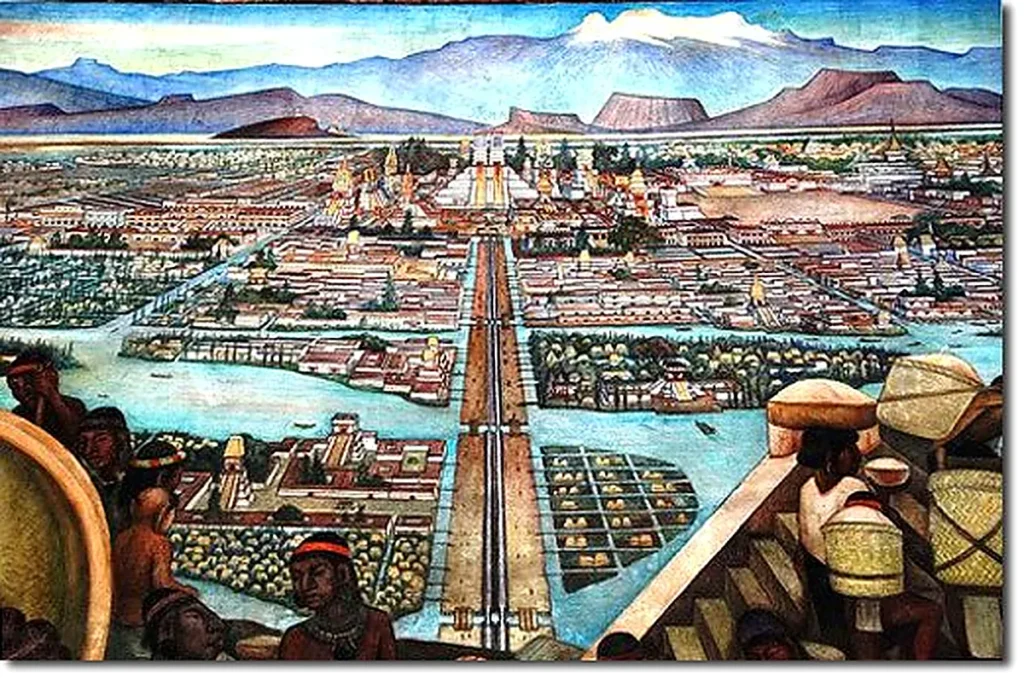
Tenochtitlan was built on a small island in the middle of Lake Texcoco, a high-altitude basin with thin soils, seasonal flooding, and almost no flat arable land within reach.
By the time the Spanish arrived, it was home to somewhere between 50,000 and 300,000 people. For comparison, London at the same moment had perhaps 50,000 inhabitants, and its sewage ran directly into the Thames.
Feeding a city on an island, with no wheeled transport and no draft animals, wasn’t a philosophical project. It was a logistical problem that had to be solved every single day.
The Mexica, the people Europeans called Aztecs, solved it with the chinampa.
What a chinampa actually is
You’ve probably heard chinampas called “floating gardens.” That’s almost entirely wrong.
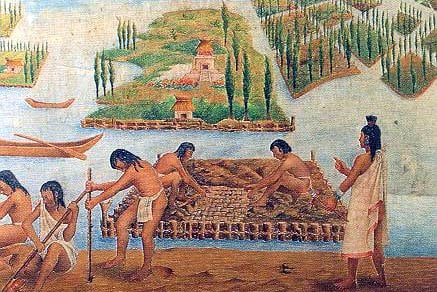
Chinampas weren’t rafts of vegetation drifting across an ancient lake. They were raised beds built within the shallow lake, constructed by piling excavated lake sediment between hand-dug canals, fixed in place, rooted in the lakebed.
The canals between the beds were the heart of the system. Water moved up into the beds by capillary action. Aquatic plants growing in the channels were cut and composted onto the beds.
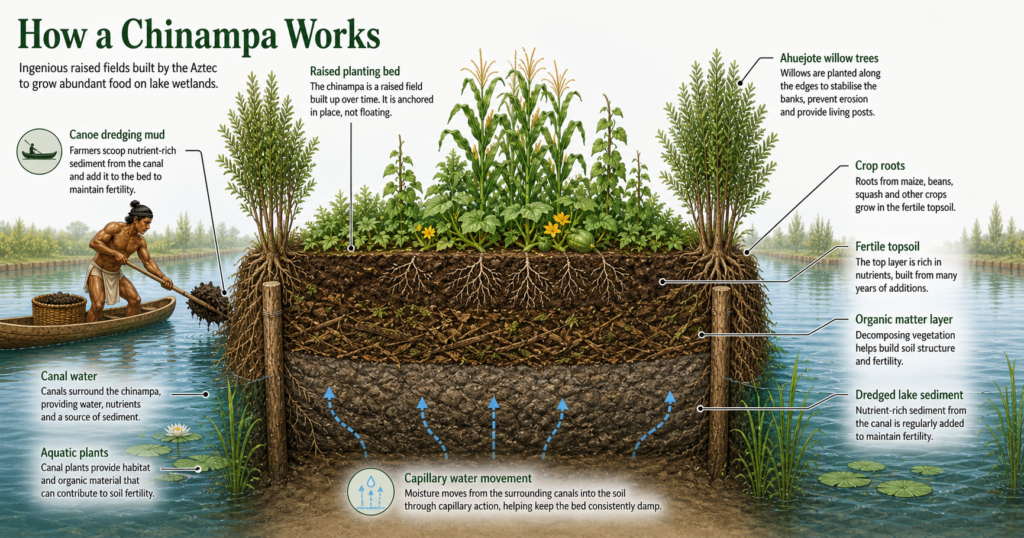
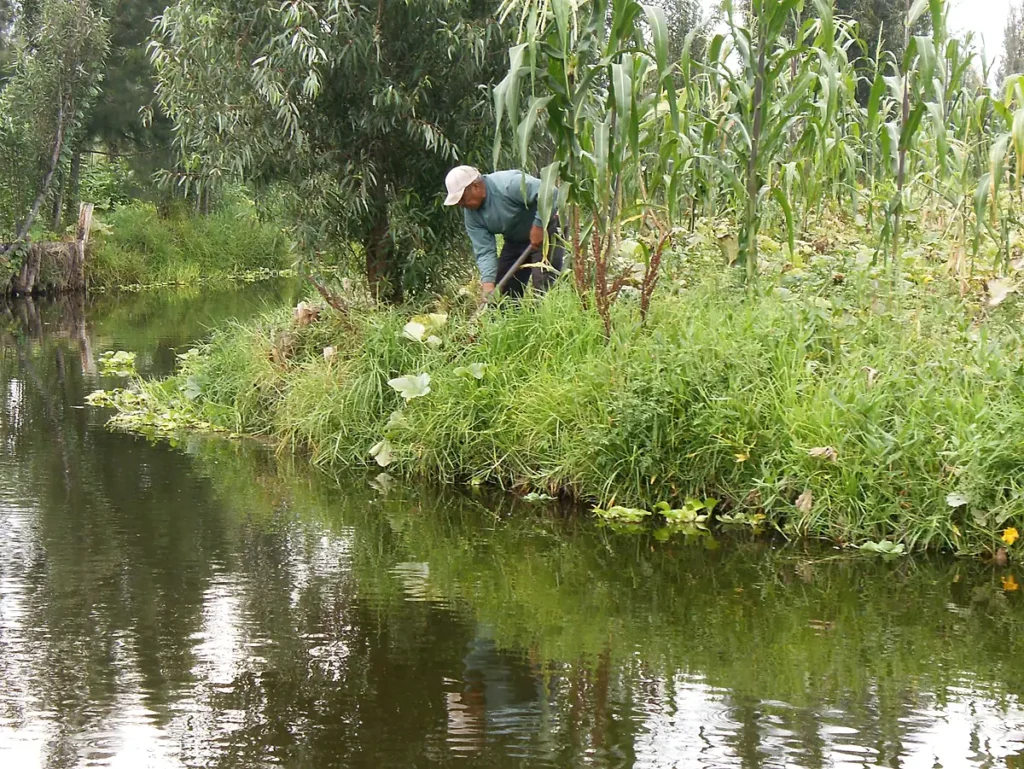
Farmers also regularly scooped nutrient-rich mud from the canal bottoms and spread it across the planting surfaces, a practice called mucking, and it was as routine as weeding. The canal water itself harboured bacteria that rapidly converted organic matter into plant-available nutrients, making the whole system self-fertilising.
The results were extraordinary. Pedro Armillas, whose 1971 paper “Gardens on Swamps” remains a foundational study of chinampa systems, documented that well-managed chinampas could support up to seven harvests per year. Treat that as an upper bound rather than a typical average, but multiple annual harvests were the norm.
The floating gardens myth

There were floating elements in Mexica farming, but they weren’t the chinampas themselves.
They were movable nursery rafts, made from rushes and cattails, used as seedbeds and towed around the lagoon to wherever they were needed. Early Spanish observers appear to have seen these nursery rafts and extrapolated the floating gardens image from there: a myth generated from a real observation of something quite different.
The actual chinampa was a permanent, engineered wetland bed that could be farmed continuously for generations.
Following the waste
Tenochtitlan had public privies built at intervals through the city, on the causeways, and in the market itself. A dedicated workforce of around a thousand people swept the streets daily, with the sweepings collected and transported by canoe.
The excrement Díaz saw being sold at Tlatelolco was part of an organised collection and redistribution system. City waste was categorised, collected, and directed wherever it was useful, mainly to the chinampas and to shore up lake banks.
Urine was handled separately. The state collected it for use as a mordant in the dyeing industry. Nahuatl even had a specific term for soil that had been urinated upon, which tells you the collection was organised enough to require its own vocabulary.
The water supply received equivalent attention. Hernán Cortés, writing to the Spanish crown in 1520, described the city’s aqueduct system with evident admiration: two parallel channels, one in use while the other was cleaned. A redundancy that reads surprisingly modern.
The lake as food
The system extended into the lake itself.
The Florentine Codex, a 16th-century encyclopaedic record of Mexica life, describes a substance called tecuitlatl: blue-green algae that grew in thick mats on the lake surface. The Mexica harvested it and made it into cakes that could be toasted and eaten. What we’d now recognise as spirulina.
Díaz, in his market description, mentions small loaves made from something he found in the lake that tasted, he thought, like cheese. Whether every mud loaf he saw was tecuitlatl is debated, but the broader point holds. The Mexica treated the lake’s surface biomass as a crop, as actively managed as anything growing in the chinampa beds.
What “waste” meant to the Mexica
The Nahuatl word for gold, or more precisely for precious metal in a sacred register, is teocuitlatl. Broken down: teo-, divine or sacred; -cuitlatl, excrement.
Gold was, in Mexica sacred language, divine excrement — the excrement of the gods.
The same framework that turned canal mud and human waste into agricultural inputs applied to the most precious material the culture knew. Excrement, in Mexica thinking, was where value began.
Why it collapsed
Chinampas worked for generations, but under specific conditions: controlled water levels maintained by the city’s hydraulic infrastructure, organised labour, and the political stability to hold it all together.
When those conditions broke, through conquest, population collapse, and the Spanish drainage of the lake basin, the system degraded. Morehart and Frederick, in their archaeological study of pre-Aztec raised-field agriculture in the northern Basin of Mexico, argue that the rise and abandonment of the chinampa system were directly linked to the political economy of the city-state — a conclusion that likely applies to the Tenochtitlan-era system as well.
This is the necessary corrective to reading this as a simple success story. The Mexica weren’t ecological idealists. Tenochtitlan was also an imperial capital sustained by tribute, military expansion, and human sacrifice. The chinampa system’s productivity was inseparable from the power structures that maintained it.
Putting lessons of history to use
Sometimes at this stage I like to take a step back and think about what us gardeners and composters can learn. And it just so happens that this story ties into an experiment I’m conducting.
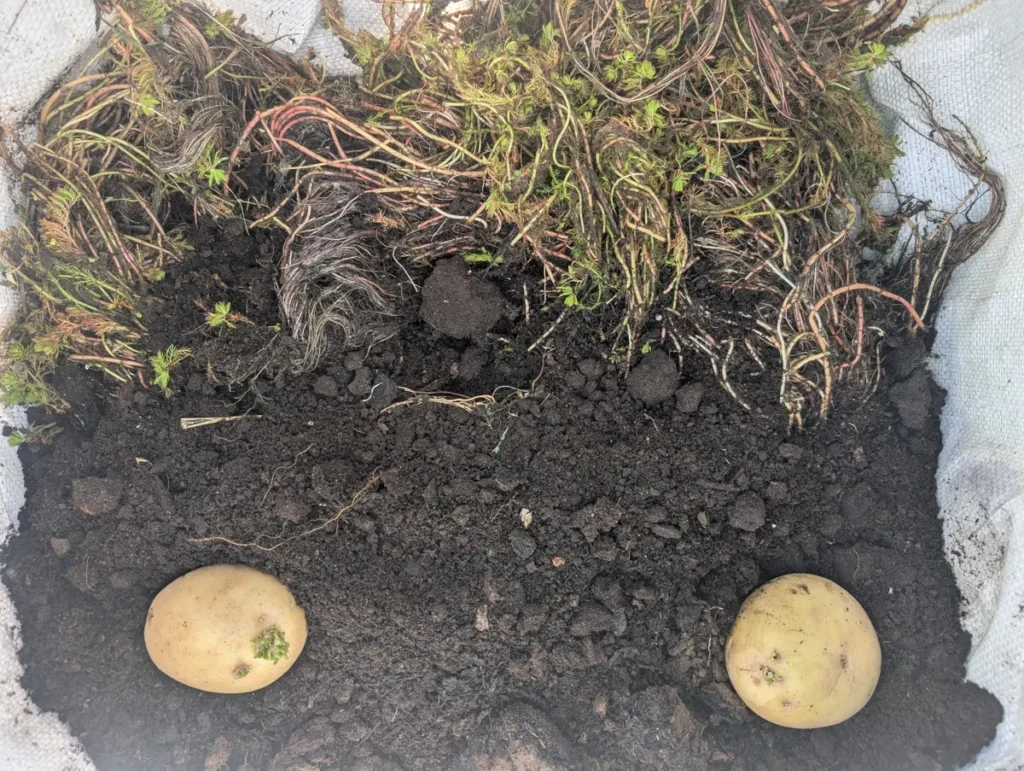
A few weeks ago I cleared my garden pond of weed and sludge. The obvious thing to do was put it on the compost heap, but as it was very wet I put it aside to dry.
Then, after researching the Bangladeshi floating rafts made of rotting river weed as well as the chinampa, I decided to add it to my potato sacks.
The logic is the same as chinampa mucking. Pond weed accumulates nutrients from the water — aquatic plants are notably rich in potassium, which happens to be exactly what potatoes need most for tuber development. The sludge from the bottom adds organic matter and releases nitrogen and phosphorus slowly, which suits potatoes better than a nitrogen hit that pushes leafy growth at the expense of the tubers.
There’s two things worth watching. Pond sediment tends to be on the alkaline side, and potatoes prefer slightly acidic conditions. Push the pH above around 6.5 and you risk potato scab. Plus, I don’t know if it will rot down fast enough to provide nutrients.
For those two reasons, I’ve mixed the sludge with compost and manure rather than using pure pond weed.
I don’t know yet whether it will work. I’ll report back when the plants come up. I have another sack with the same potatoes but only compost and manure, so it’ll be a good split test.
My instinct isn’t as strange as it sounds. Egyptian farmers depended on Nile silt for thousands of years. British farmers spread dredged lake marl on their fields from Roman times through the 18th century. Aquaculture farmers in Bangladesh still routinely apply fish pond sediment to their rice paddies. The chinampa farmers of Tenochtitlan were doing the same thing, at city scale, five hundred years ago.
It turns out clearing out a garden pond and wondering what to do with the muck is a question people have been answering, in one form or another, for a very long time.
A note on the numbers: estimates for Tenochtitlan’s population range widely — from around 50,000 to over 300,000 — and the scholarly debate is unresolved. “Up to seven harvests per year” represents an upper bound under intensive chinampa management, not a typical average.
Related Posts
- Compost History: The Fascinating Story of an Ancient Science
- The Founding Fathers Who Were Obsessed With Compost
- The Indore Method: Where Modern Composting Began
References
- Bernal Díaz del Castillo, The True History of the Conquest of New Spain. Project Gutenberg.
- Pedro Armillas, “Gardens on Swamps,” Science (1971).
- Roland Ebel, “Chinampas: An Urban Farming Model of the Aztecs and a Potential Solution for Modern Megalopolis,” HortTechnology (2019).
- Becerril & Jiménez, “Potable water and sanitation in Tenochtitlan,” Water Supply (2007).
- Cecelia F. Klein, “Teocuitlatl, ‘Divine Excrement,'” Art Journal (1993).
- Hernán Cortés, Second Letter to Emperor Charles V (1520). Wikisource.
- Sahagún, Florentine Codex tradition, via Ortega et al., Journal of Ethnobiology (2001).
- Morehart & Frederick, “The chronology and collapse of pre-Aztec raised field (chinampa) agriculture in the northern Basin of Mexico,” Antiquity (2014).