If you owned a building in one city, your tenants’ toilet output could earn you nearly twice a carpenter’s annual wage. In London, at the same time, your tenants would have thrown it out the window.
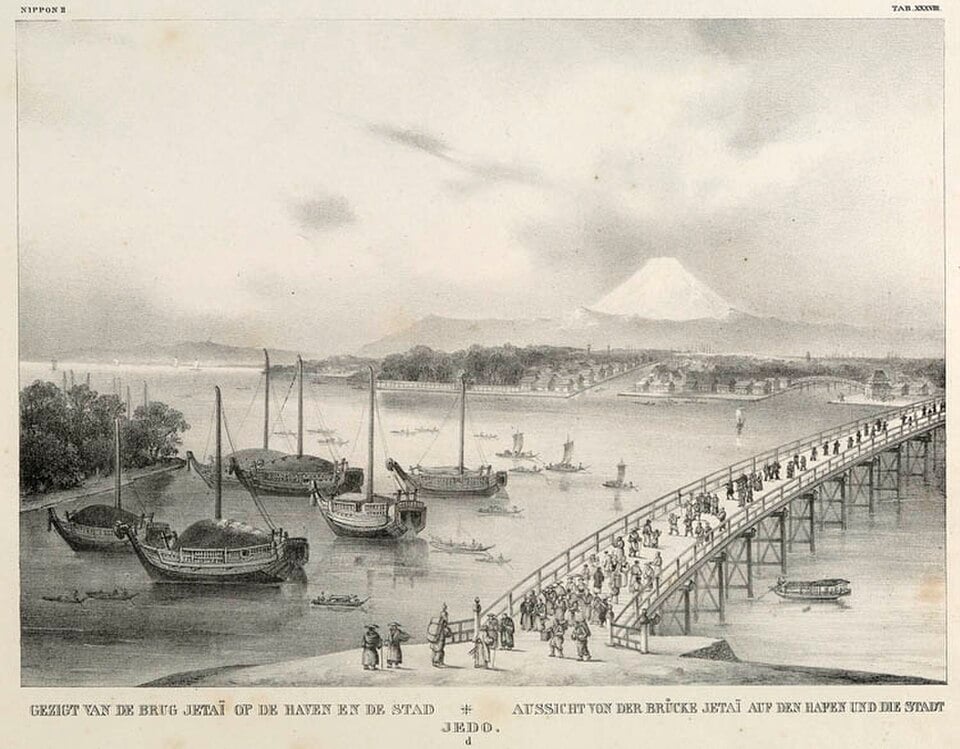
Welcome to Edo, home to a million people by the early 18th century, by some estimates the largest city on earth. Yet it had no sewers. Instead it had a market for human waste.
When waste is valuable
In countries in the West, animals provided much of the manure needed for fertility – but Japan had limited livestock.
Buddhism had kept meat off the table for centuries, and cattle and horses were kept for work, not food. To fill the gap, farmers turned to human waste.
The system was called shimogoe, roughly “fertiliser from below.” Farmers contracted with city households through a formal agreement called tsuke-tsubo, paying upfront in rice, vegetables or, by mid-Edo period, silver, for the right to collect all waste from a property over the course of a year.
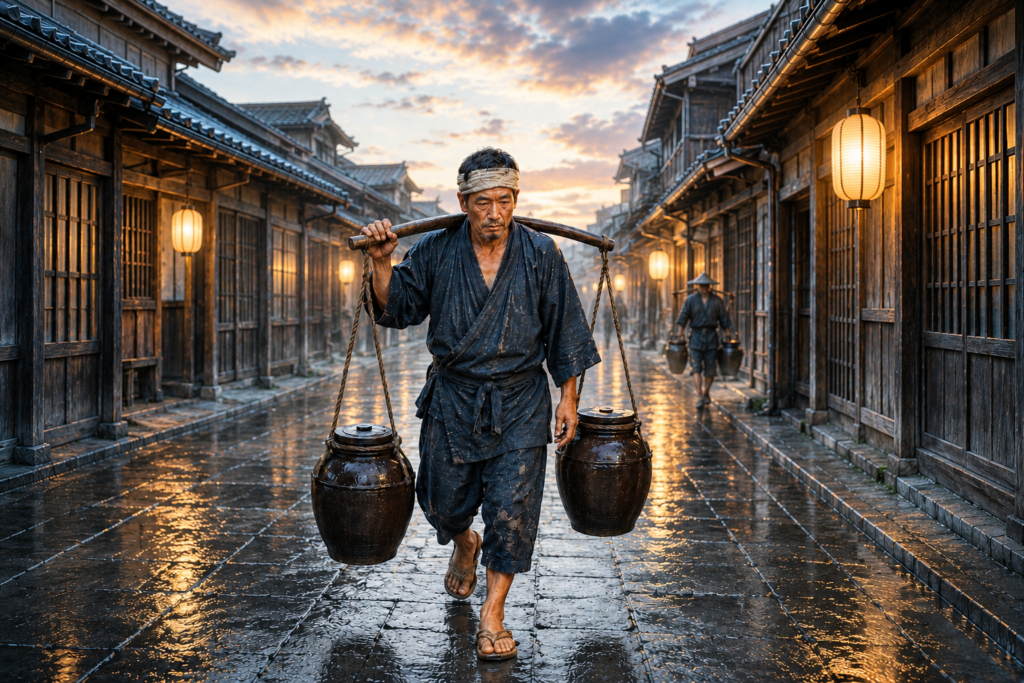
Collection happened before dawn. Specialist collectors moved through the streets carrying koe-oke, two sealed pottery jars on a shoulder pole. As the market grew, warehouses appeared, then specialist retailers, then professional middlemen. Landlords with large tenement buildings could earn 30 to 40 ryō a year from their privies alone. The American scholar Edward Morse documented cases where waste from just three tenants paid one person’s rent entirely — and from five tenants, paid no rent at all.
(That’s something like £18,000 to £27,000 in today’s money. As you can imagine, converting Edo-era currency across four centuries is an inexact science!)
In Osaka, the trade ran on boats. Farmers sent vessels into the city loaded with vegetables and returned with night soil. The exchange was so commercially serious that people risked prison to steal shit, and in the ‘poop wars’ two villages even went to court over the rights to shit.
It was even rumoured that particularly mean people would rush home after dinner at friends, bottom cheeks clenched, rather than give back the results of that meal.
Why rich shit was better
The price wasn’t fixed. At the top sat the waste from feudal lords’ estates, where servants ate well and the nutrient content reflected it.
Wealthier households throughout the city commanded a premium. Some areas were prized specifically for growing premium Japanese tea, and those farmers were particular about their sources.
A city without a stink
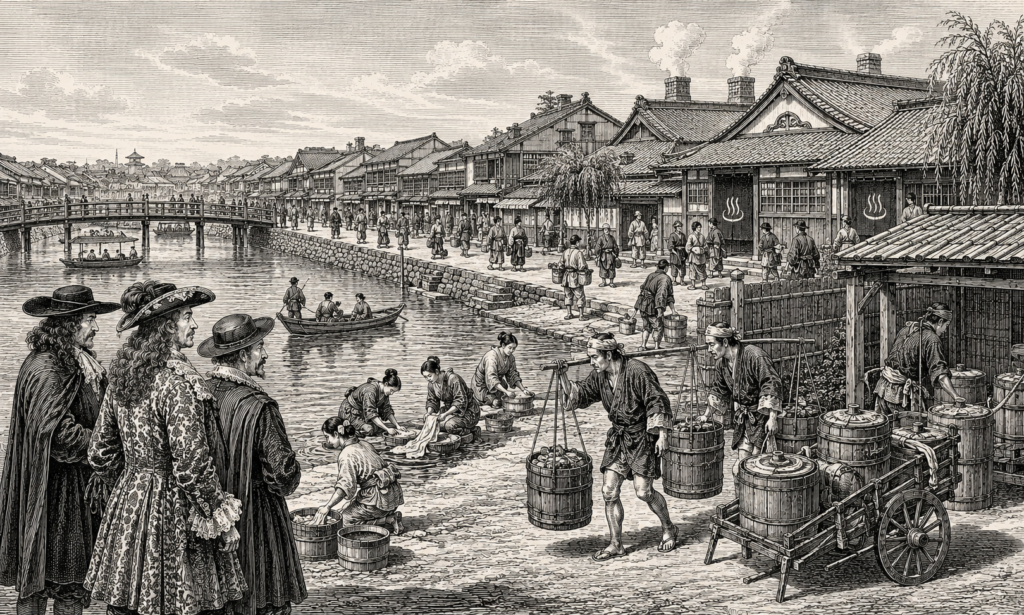
European visitors consistently noted the absence of the stench familiar from Paris and London, where disposal meant the window and the street below. In Edo, the rivers were clean enough to bathe in. The German physician Engelbert Kaempfer, visiting Japan in the 1690s, observed that “care is taken, that the filth of travellers be not lost” with roadside facilities positioned specifically to capture passing waste.
That cleanliness wasn’t accidental. It was a byproduct of the market. When waste had value, nobody left it lying around.
The end of shimogoe
The shimogoe system didn’t collapse. It was made redundant.
Modernisation brought rapid urbanisation. As Tokyo grew, the distances between collection points and farmland grew with it, and transport costs rose past what the market could bear. In 1930, the Filth Cleaning Law moved waste handling to the municipal government. After the Second World War, cheap synthetic fertilisers removed the last reason to collect. By around 1955, a system that had run for over three centuries was finished.
What replaced it was cheaper and more efficient. It also turned something that had fed fields for centuries into a problem to be treated and discharged. And that problem is still with us.
Related articles
- How Humanure Could Change The World
- Compost History: The Fascinating Story of an Ancient Science
- Manure in Compost: Turning Sh**t into Black Gold
Sources
- Hanley, Susan B. “Urban Sanitation in Preindustrial Japan.” Journal of Interdisciplinary History, 1987.
- “The Marketing of Urban Human Waste in the Edo/Tokyo Metropolitan Area.” Hitotsubashi Journal of Economics, 1998.
- “Japan’s Sustainable Society in the Edo Period.” Japan for Sustainability, 2005.
- Szczygiel, Diane. “From Night Soil to Washlet.” Electronic Journal of Contemporary Japanese Studies, 2016.
- “History of Meat Consumption in Japan.” Wikipedia.
- Traphagan, John W. “Raising a Stink.” Guernica Magazine, 2014.
- Zeldovich, Lina. “Raising a Stink.” Guernica Magazine, 18 November 2021. Adapted from The Other Dark Matter: The Science and Business of Turning Waste into Wealth and Health. University of Chicago Press, 2021.