I’m always intrigued by the more esoteric edges of composting.
Unfortunately, some of my desires to experiment, such as those with cockroach composting and humanure toilets, have been frustrated by what I can only explain as a family intervention.
However, I’ve had no objections to my latest project, woodlice composting, and I don’t anticipate any (unless someone stumbles across my hidden woodlice bin).
I wanted to get that out of the way, because traditionally in an article like this you’d have a “Why compost with woodlice” section – and I can’t think of anything other than “because I want to know if you can.”
If you’re reading this, you probably want to know too.
But first, let’s make sure we’re both talking about the same thing!
What are woodlice?

The readers of this website come from around the world, but with a clear majority from the USA and the UK.
That doesn’t usually matter, but Americans and Brits use very different words for the creatures we are talking about today.
In the UK, we call them woodlice.
However, if you are from the US you’ll probably call them sowbugs.
To keep things even, let’s call them by their proper name: Isopods.
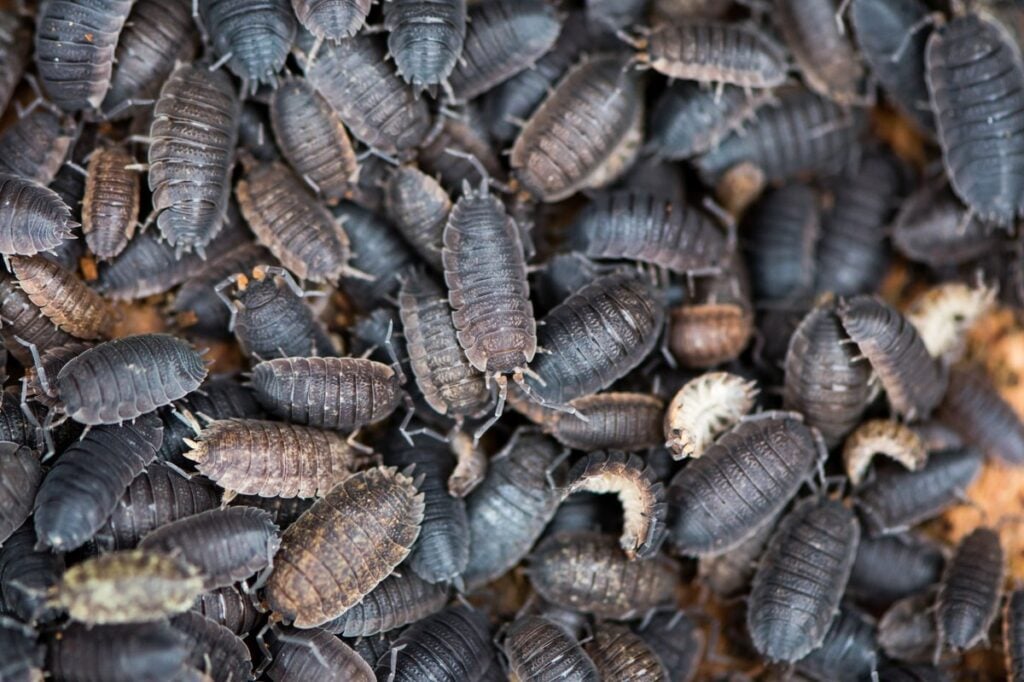
Isopods are fascinating creatures that breathe through lungs in their hindlegs, excrete ammonia as a gas instead of peeing and love eating their own faeces.
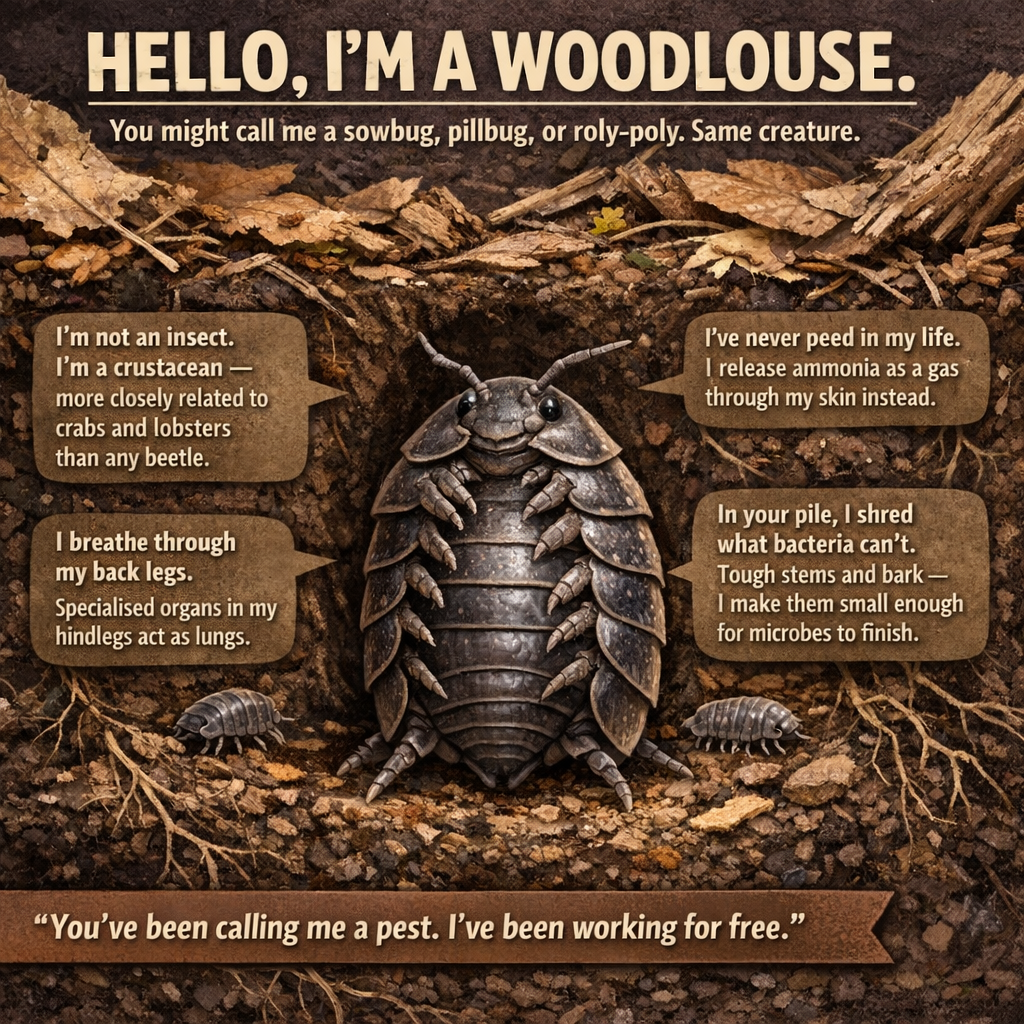
Although we often think of them as insects, they are actually a terrestrial crustacean closely related to crabs and lobsters.
These crustaceans can reach incredible densities, with scientists recording as many as 10,000 woodlice per square meter. (1)
Are Isopods any good for composting?
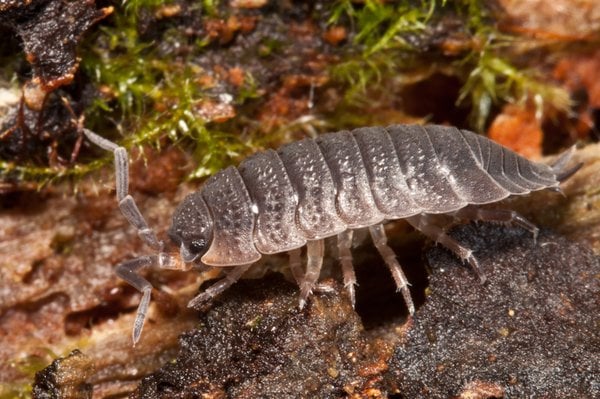
There’s been limited research into the role of isopods in composting.
That said, their appearance is considered to be a good sign in the
We know they act as micro shredders, feeding on tougher material not typically broken down in the first stage of composting, increasing its surface area and making it available to the bacteria and fungi for further breakdown.
They may also further enrich the compost with their own faeces, making more nutrients available for other decomposers.
Heavy metal fans
One of the few studies I did find looked at making compost from sludge with:
- Worms
- Isopods
- Worms and isopods
The study found that woodlice had the ability to remove heavy metals from compost material.
However, the best results came from using worms and woodlice together.
This synergistic relationship not only resulted in more heavy metals being removed, it also led to the highest quality compost from the three tests. (2)
Note that the study didn’t explain how the worms and woodlice remove heavy metals, or what happens to the heavy metals! However, at least one researcher has suggested that there is an enzyme in worms’ guts that detoxifies heavy metals.
What I hope to learn from this experiment
1. Can I keep them alive?
First, I want to find out if I can create the right conditions for isopods to survive.
That’s tricky, given the paucity of information available.
One clue for food sources comes from CarryOnComposting, as they find that woodlice seem to like coffee.[3]
I’ll need to try adding some coffee grounds, and monitor the bin to see if the isopods are attracted to it.
RedWormComposting also suggests using a well-ventilated, damp system with plenty of cardboard. [4]
2: Will they make compost I can use?
If I can actually farm the woodlice, I’d like to see if they create enough compost to actually use.
3: Can I grow anything in it?
Finally, assuming I get any compost out of it, I’d like to see if I can actually grow something in it!
Even if the experiment does fail, I hope to learn something from it which will let me explore farming woodlice together with worms.
Getting started
So far I’ve learned what woodlice like: bedding that is damp but not too damp, plenty of ventilation and coffee!
That said, I think this experiment has a high risk of failure, as I don’t have any guidelines to follow.
Because of that, I’m going to keep things small and simple.
The setup
To house the woodlice, I’ve simply taken an old food waste bin (previously used as a bait box for fishing trips) and drilled holes in the bottom, side and top.
I’ve kept the holes pretty small – hopefully not too small for ventilation.

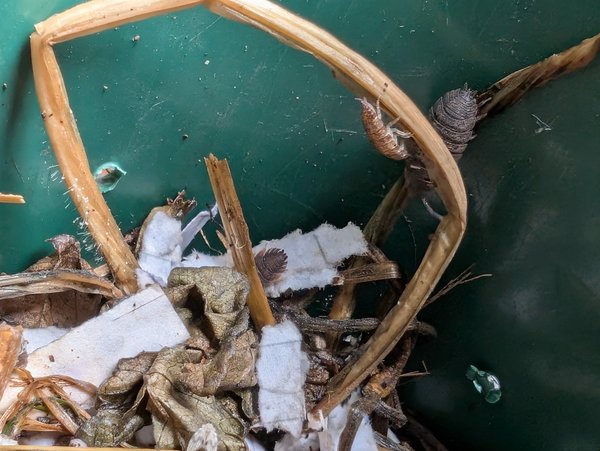
After drilling the holes, I filled the bin with shredded paper, a bit of old compost, some leaves and some decomposing plant leaves.
I moistened the bin, but tried not to get it too wet.

I also included some dry shredded paper at the top just in case they fancy a drier environment.
I then needed some woodlice!
Collecting the woodlice
Fortunately, as usual there were some on the lid of my insulated

Because they are from my
However, I did top the bin up with some more woodlice from under various pieces of wood around my garden.
Finally, I tucked the small bin away in my wood shed for some protection against the rain.
Going forward, I’ll be monitoring the bin to ensure it’s moist (but not too wet) and to see what’s happening to the compost material.
What next?
Like most composting experiments, this is going to take some time.
Whether it’s a success or a failure, I’ll update you here as I get results.
Wish me luck!
FAQs
What do woodlice eat?
One of the keys is in the name – woodlice do indeed eat wood, albeit mostly dead and decaying wood. But that’s not all they eat – they’ll also eat leaves, decaying plant matter and even their own faeces. They have been known to eat live plants but this is rarer. Experiments by composters show they are also rather fond of coffee – I’ll be testing this in my experiment.
Do note that there are many species of woodlice, and the exact food they eat depends on the species – some even eat flesh!
How many legs do woodlice have?
Woodlice have an impressive 7 pairs of legs – meaning they have 14 in total!
How long do woodlice live?
For such a tiny creature, woodlice can live surprisingly long, with some sources suggesting they can thrive up to four years before finally kicking the bucket.
Sources
1. Nakamura, Y., Kaneko, N., & Wada, N. (2019). Decomposition of forest litter and feces of Armadillidium vulgare (Isopoda: Oniscidea) produced from the same litter affected by temperature and litter quality. Forests, 10(11), 939. https://doi.org/10.3390/f10110939
2. Ahadi, N., Sharifi, Z., Hossaini, S. M. T., Rostami, A., & Renella, G. (2020). Remediation of heavy metals and enhancement of fertilizing potential of a sewage sludge by the synergistic interaction of woodlice and earthworms. Journal of Hazardous Materials, 385, 121573. https://doi.org/10.1016/j.jhazmat.2019.121573
3. Carry On Composting. Compost creatures https://www.carryoncomposting.com/416920206.html
4. Red Worm Composting. (2012, September 21). Bentley’s ultimate bin-09-21-12. https://www.redwormcomposting.com/large-scale-vermicomposting/bentleys-ultimate-bin-09-21-12/