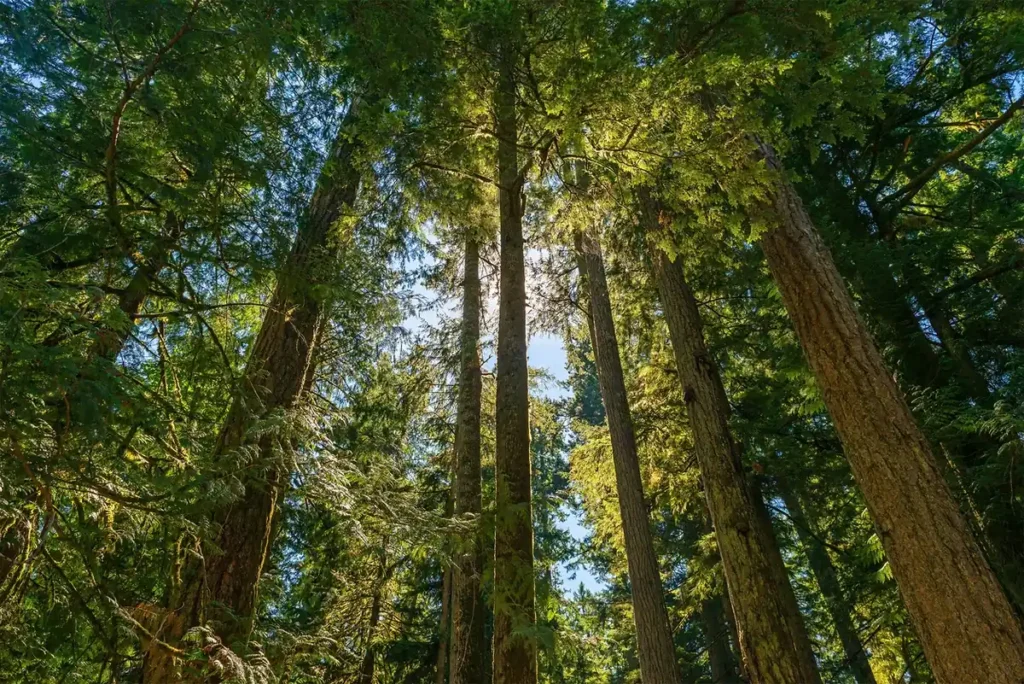
There is a Douglas fir on Haida Gwaii that is several hundred years old. Its roots go into soil that has never seen the ocean. Yet when scientists analysed its growth rings, they found that up to 80% of its nitrogen came from the Pacific.
And it’s all down to fish.
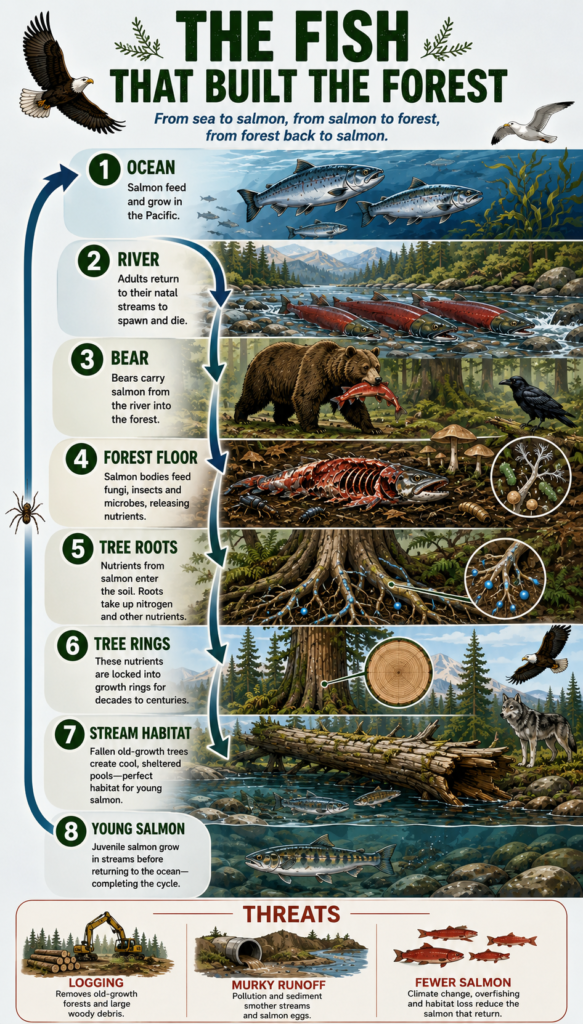
Pacific salmon begin their lives in the rivers of British Columbia, but gain most of their body mass in the open Pacific.
Once mature, they return to the rivers to spawn, and then die. And there, waiting for their arrival, are bears.
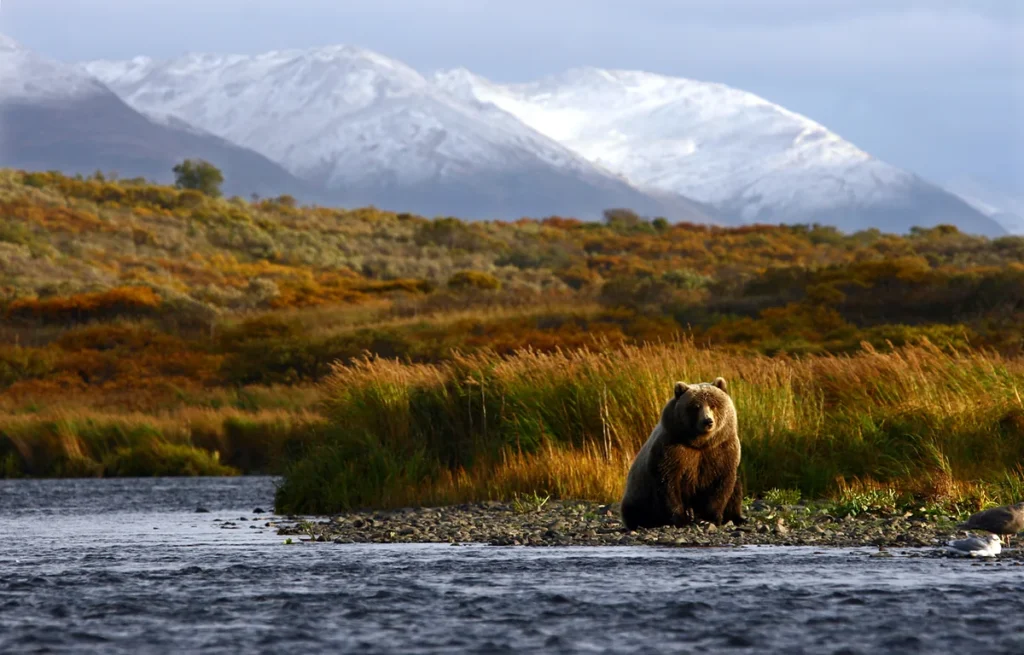
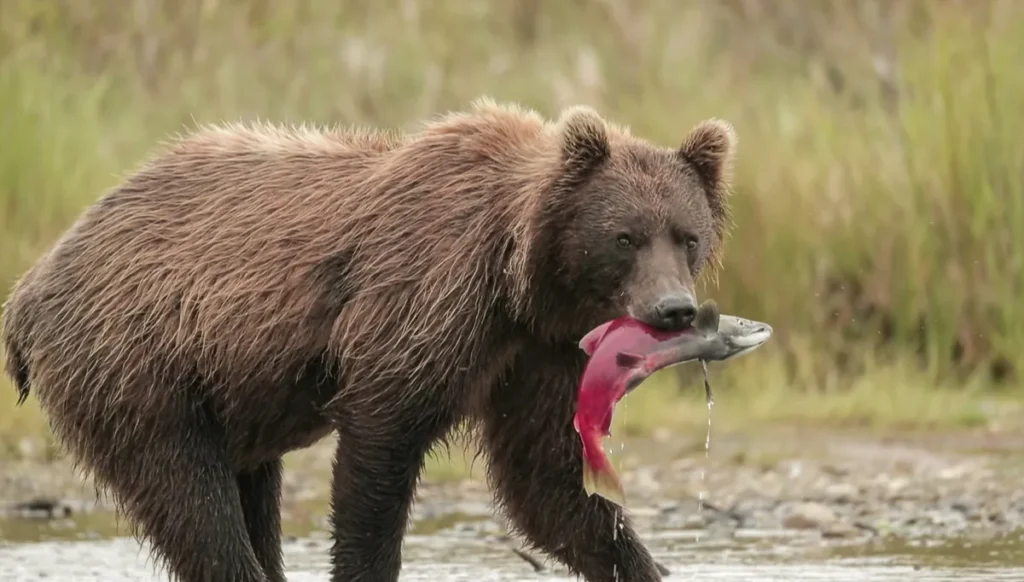
During the 40-day spawning window, a single brown bear will catch and carry roughly 700 salmon away from the water and into the forest. When salmon are abundant, bears eat less than half of what they catch. The rest decomposes where it lands, among the roots of the trees.
There the carcasses are broken down by microbes, releasing nitrogen into the soil.
The nitrogen carries a chemical fingerprint from the sea. Scientists can spot it because marine nitrogen has a different balance of nitrogen-15 and nitrogen-14 from nitrogen produced on land. When the trees take it up through their roots, that fingerprint is stored in their growth rings.
Tom Reimchen, a biologist at the University of Victoria, spent years reading those rings. His team cored 417 trees across 364 sites and 55 watersheds along British Columbia’s coast.
The marine nitrogen signal appeared in every watershed with active salmon runs, and it was proportional to salmon density. Near productive spawning rivers, trees grew measurably faster than those even a short distance from the water.
Bears are the most visible part of this system, but not its only working part. At a single stream on Bag Harbour, Reimchen counted 2 martens, 4 eagles, 12 ravens, 150 gulls, and 250 crows during the run. Wolves, in the spawning season, can derive up to 50% of their diet from salmon. Each animal that takes a fish away from the water extends the nitrogen’s reach further into the forest.
A single carcass can move through more than 60 insect species before its nutrients finally settle into the soil. The marine signature has been traced into spiders living high in the old-growth canopy – animals that never approach the river, eating insects that ate fish, in trees built partly from the sea.
The forest returns the favour. Old-growth trees, when they fall into rivers, create backwater pools. In the slow, sheltered water of these pools, juvenile salmon can rest and feed without being swept downstream.
The tree rings hold a record not only of salmon abundance, but of human history. Reimchen found that the nitrogen-15 signal in the rings of some trees was virtually absent until around 1900, then rose sharply. The timing corresponds to a period when the Haida, the Indigenous people of Haida Gwaii, moved away from those particular streams, and bears, undisturbed, resumed fishing freely.
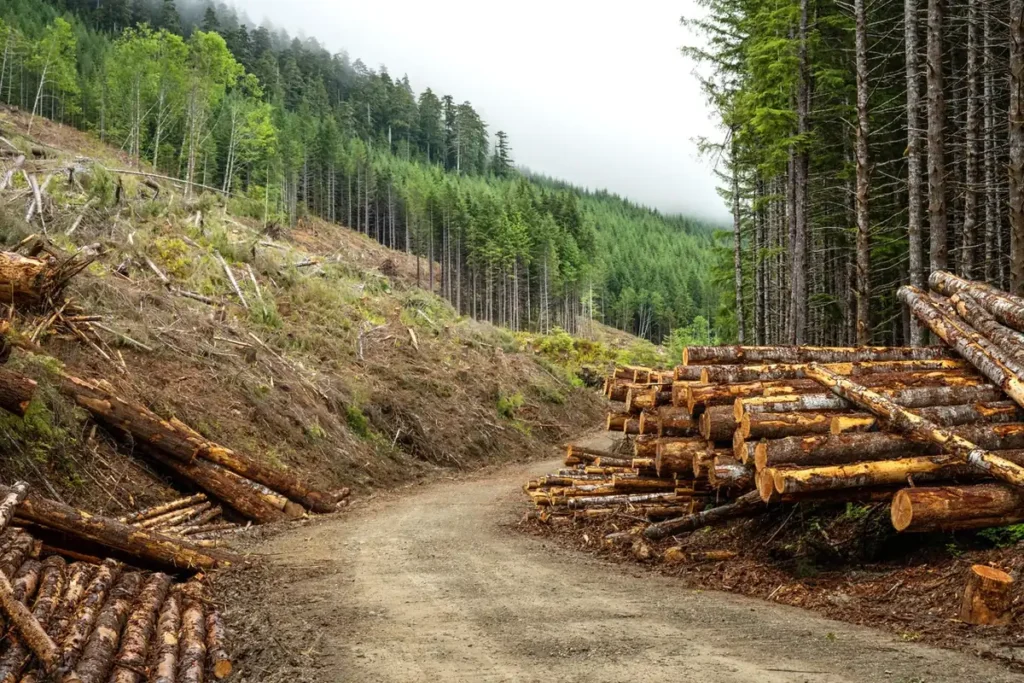
More recently, logging has damaged the system from another direction. At Rivers Inlet, removing old-growth forest left rivers running murky with runoff, hindering salmon migration upstream. Log debris destroyed between 25 and 30% of the estuary – the shallow, sheltered water where juvenile salmon develop before heading to sea.
Pacific salmon populations have declined by around 85% since 1947. At Rivers Inlet on British Columbia’s coast, the sockeye run that once delivered more than three million fish annually had fallen, by the time researchers were studying it, to around 300,000 – and in the worst years, far below that. One season, 3,500 fish returned where 300,000 had been expected.
The bears that depended on that run came into the local village. By early December, 15 had been shot. When the bodies were examined, they had barely an inch of fat on them. The bears were starving.
When the salmon disappear, the damage does not stop at the riverbank. Less food reaches the bears. Fewer carcasses reach the forest floor. Less marine nitrogen reaches the trees.
That is what makes the old Douglas fir on Haida Gwaii so remarkable. Its rings do not just record rain, drought and passing years. They record fish. They record bears. They record the sea arriving, year after year, in a forest that never touches the ocean.
Related articles
Sources
- Reimchen, T.E. (2000). Some ecological and evolutionary aspects of bear-salmon interactions in coastal British Columbia. Canadian Journal of Zoology, 78(3), 448–457. https://doi.org/10.1139/z99-232
- Helfield, J.M. & Naiman, R.J. (2001). Effects of salmon-derived nitrogen on riparian forest growth and implications for stream productivity. Ecology, 82(9), 2403–2409. https://doi.org/10.2307/2679924
- Holtgrieve, G.W., Schindler, D.E. & Jewett, P.K. (2009). Large predators and biogeochemical hotspots: brown bear (Ursus arctos) predation on salmon alters nitrogen cycling in riparian soils. Ecological Research, 24, 1125–1135. https://doi.org/10.1007/s11284-009-0591-8