I didn’t scream.
Honestly, it was more of a gasp (a claim I can make only because I was the only person at the bottom of the garden at the time). I’d opened the lid to the
I’ve dealt with mice in compost before, but they never have the same impact. Both breed fast, damage crops and spread nasty diseases like Leptospirosis (Weil’s disease) and Hantavirus. However, rats come with a “fear factor” and a level of destruction that mice just can’t match.
I’ve been battling rats since I was a child growing up in the countryside. After more decades than I care to admit, here’s what I’ve learned about keeping them under control.
The math of a rat infestation
If you have ever seen a couple of rats in your garden, you will notice how quickly sightings increase. This rapid growth is driven by:
- Fast Maturity: Wild rat pups reach sexual maturity in as little as 8–12 weeks, allowing populations to overlap quickly.
- Rapid Breeding: A single female can have up to 6 litters a year. Under ideal conditions, a pair can result in a colony of over 1,000 rats within 12 months.
- Survival Strategy: They produce massive numbers of offspring to ensure the colony survives despite predators and pest control.
According to research by Rentokil, a single pair of rats can produce nearly half a billion descendants in just three years if left unchecked. While that’s a hypothetical situation—and undoubtedly a little exaggerated—even the real-world growth rate is staggering enough to justify taking immediate action the moment you spot a burrow.
If you’re in a hurry…
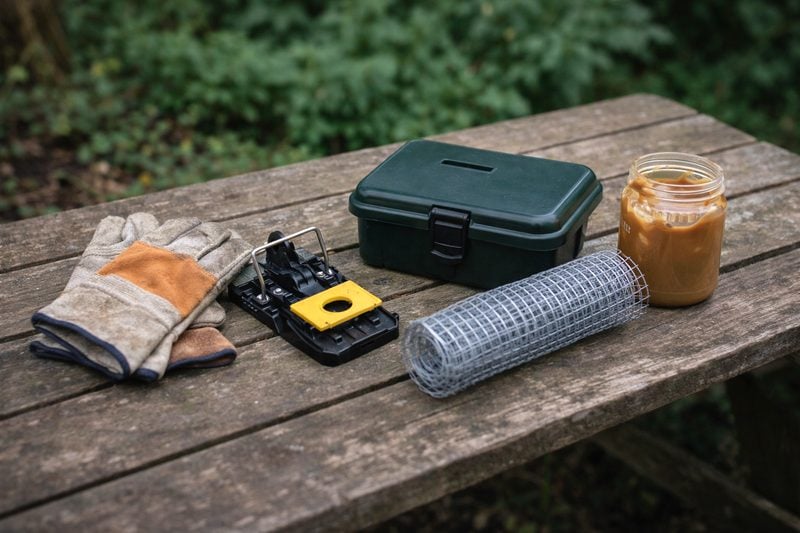
While I hope you read this post from top to bottom, here is a go-to kit when I need to deal with a rat infestation quickly:
Traps Live traps are a hassle. I prefer snaps traps – just make sure you choose a large, heavy-duty trap designed specifically for rats, not mice. I prefer easy-set traps, but the old fashioned ones will do the job too (just watch your fingers!)
The Best Bait: I find peanut butter, Mars Bars, or Snickers work a treat, especially when it’s dry.
Bait stations: Poison should be avoided when possible – but sometimes the only way to fully get rid of a colony. However, it is essential to keep the poison away from other animals. Use a locking station or, failing that, a turned-over bucket with a heavy stone on it.
Physical deterrents: Where feasible, block access into compost bins using heavy-gauge wire or wire mesh (16–19 gauge).
Read on for the full strategy and safety tips!
First: Remove alternative food sources
Rats are more challenging to control than mice because they have neophobia – a fear of new things. It can take them time to get used to traps or bait stations, which can be frustrating when you have an infestation.
So it’s key to try and remove any other food sources. When rats have nothing else to eat, they are more likely to be attracted to bait.
I have chickens, which always increases the attraction to rats. To limit food availability, I keep chicken food in a galvanized steel bin with a heavy stone on the lid. I’ve also switched to an automatic chicken feeder, which is calibrated to open only when a bird of a certain weight steps on it.
If feeding wild birds, try and limit feeding times to morning when rats are less likely to appear.
Finally, consider temporarily switching to trench composting to get rid of scraps – you’ll still be composting food waste, but it’ll be out of sight and scent for rats!
Using traps to control rats
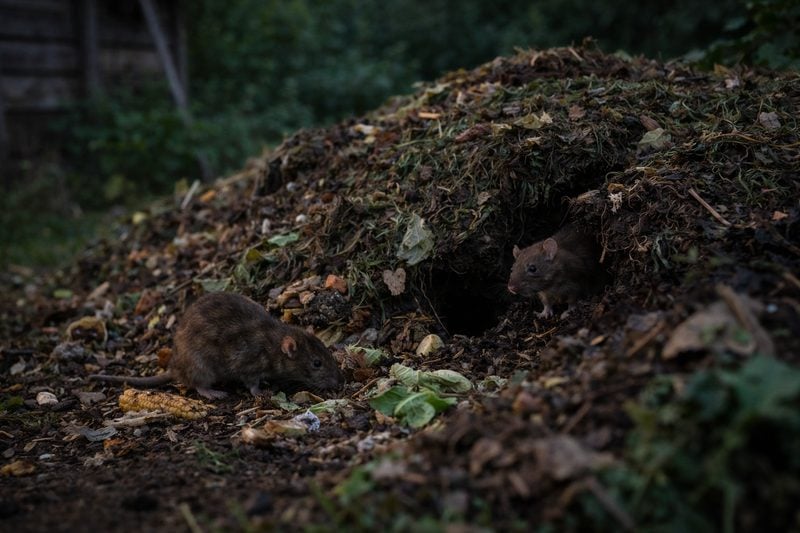
I’ve used all sorts of rat traps, from traditional wood and metal snap traps to fancy electric devices.
They all catch rats, but I do have my preferences.
First, I’d personally prefer not to use live traps. My family used live traps extensively when I was young, and we caught a lot of rats. We also caught crows, hedgehogs (terrible to get out) and an owl! (The owl took a chunk out of my hand, which I guess is fair enough.)
When you catch the rats, you either have to kill them or release them. My dad used to drown them, which I thought was a horrible, slow way for them to die.
You can’t release them close to the house, or they will come back. So you have to drive miles away and let them go – and unless you are far from houses, there’s a good chance you are just transferring the problem to someone else.
For that reason, I prefer something that will kill the rat fast. I use a large, heavy-duty trap designed specifically for rats. Using a smaller trap is a mistake – you risk injuring the animal without a clean kill.
The traditional “wood and metal” snap traps are very effective and budget-friendly. However, I am clumsy, and worry about catching my fingers! I prefer “easy-set” traps, which allow you to set them without risking your fingers.
|
Traditional Rat Traps

|
Live Rat Trap

|
Heavy-Duty Snap Trap

|
|
Our Rating:
3.9
|
Our Rating:
4.2
|
Our Rating:
4.5
|
|
A nice take on traditional traps with plastic pedals to ensure you don't trap your fingers. |
Catches multiple rats at the same time - but don't forget you have to get rid of live rats! |
Enable you to get rid of the rat without having to touch it. |
A nice take on traditional traps with plastic pedals to ensure you don't trap your fingers.
Catches multiple rats at the same time - but don't forget you have to get rid of live rats!
Enable you to get rid of the rat without having to touch it.
What’s on the menu? (The best baits)
I’ve found that the rats in my garden tend to prefer something sweet and full of sugar. (Or perhaps they just fancy a change from vegetable peelings!) When it’s dry, or if your trap is closed to the elements, I suggest:
- Snickers Bars (the nuts + caramel seem to be irresistible)
- Nutella
- Peanut butter
- Mars Bars
Where to set your traps
Don’t just place a trap in the middle of the garden and hope for the best. Instead, think about:
- Walls and lines: Place your traps (inside their stations) directly against the sides of the
compost bin , garden walls, or greenhouse edges. - Prebait: Consider pre-baiting your rat trap to get around neophobia. This involves putting bait on or around your trap before setting it for several days. When the rat is used to the trap and the bait, you then set it.
- Rat holes: If you’ve spotted a burrow entrance, place the station close to the hole.
- Safety: Don’t leave a rat trap out in the open. If you do, you aren’t just targeting rats; you’re risking the lives of non-target wildlife such as birds. If nothing else, put a bucket over the trap with a stone on it, ensuring there is a small gap for the rat to get in.
The poison dilemma
I hate using poison. I don’t like killing rats in the first place, but if it has to be done, I prefer it to be quick and clean. There is also the persistent worry about “secondary poisoning” – the impact on owls or hawks that might eat a poisoned rat.
However, in my experience, poison is often the only way to truly “clear the decks.” While traps can put a dent in a population, they often fail to eliminate it entirely. Poison, when used correctly, is the most effective way to remove a colony that has already moved in.
If you decide to use it, here are my rules for doing it right:
- Act Fast: Don’t wait. As we’ve already seen, rat populations grow fast. The longer you leave it, the more expensive and difficult the cleanup becomes.
- The “One and Done” Myth: Don’t put poison down once and assume the job is finished. Repeated doses are often required.
- Scent Management: Always use gloves. This isn’t just for your safety; it prevents chemical smells (like soap or tobacco) from contaminating the bait. Rats are used to human scent, but strong chemical odors can make them avoid the bait entirely.
- Safety First: As I mentioned at the start of this article, never put poison out in the open. Instead, ensure it is within a container that a rat can access, but other creatures (or children!) can’t.
Professional-grade rat bait station with a secure lock and key to keep poison contained. Made from hard, weather-resistant plastic, with a discreet green design that blends into garden areas.

Animal control: Nature’s rat catchers
Another way to control rats is with natural predators. Now, getting a pet is a massive commitment, and I’d never recommend getting a dog purely for pest control. But if you’re already a dog lover, choosing a specific breed can make a world of difference.
Dogs: The terrier factor

Not just any dog will do. If you want a “ratter,” it’s hard to beat a Terrier.
Jack Russells are the classic choice, though even then, there are no guarantees! My first dog—a Jack Russell crossed with who-knows-what—refused to go anywhere near a rat after being bitten once during a joint attempt to kill a trapped rat in our porch.
If you want a worker, it’s often best to look for a pup from a known “ratting” line. If you aren’t ready for a dog of your own, you might even find a local owner willing to let their dog “work” your garden for an afternoon.
Cats: Size matters
Cats are phenomenal for mice, but rats are a different story. A large rat is a formidable opponent, and many cats are simply too sensible to take them on.
For effective rat control, you need a big, tough “farm cat” style of feline. If you’re looking for a kitten, I’d suggest finding a mother known for hunting and picking the biggest, boldest kitten in the litter.
Ferrets: The ultimate deterrent?
Growing up, I was always told that rats are so terrified of the smell of a ferret that the mere presence of one can cause a colony to pack up and move out of the garden immediately.
I’ve never kept them myself, largely because of the “stink” factor (they can be very affectionate, but they certainly have a unique aroma!), but those who do swear by them.
Composting tricks for pest deterrence
Turn up the heat

Rats are opportunists, but they aren’t fans of a sauna. A well-managed, hot compost heap is physically uncomfortable or even dangerous for them to burrow into. What’s more, the heat quickly breaks down any food, making it inedible for pests.
I’ve even managed to compost dead chickens in hot compost heaps this way without any rodent problems.
Despite what you may have read, it’s not that hard to get a compost heap hot – just follow these five rules of hot composting!
Bury the “good stuff”
When adding scraps such as kitchen waste, dig a hole in the center of the pile, dump them in, and cover them. For cooked food, I like to go about a foot deep, or more if the material is loose – it’s surprising just how well wild animals can detect food. This traps the scent and accelerates breakdown.
Be realistic. In a wet January, your pile will likely cool down. This is the “high-risk” season when rats look for shelter. If you can’t keep it hot or dig it deep, stop adding “high-aroma” food scraps until spring.
Manage the “scent trail”
A soggy, anaerobic heap doesn’t just smell bad to your neighbors—it’s a beacon for rodents.
If your heap smells like rotten eggs, it’s too wet. Add shredded cardboard or dry straw and aerate it. A “sweet-smelling” aerobic heap is much less attractive to a rat’s sensitive nose, and food waste will break down far more quickly.
Physical barriers
If you are serious about stopping rats before they get established, you have to outsmart their teeth and their “squeeze-factor.” While it’s nearly impossible to rat-proof an open heap, you can secure a bin by using the right wire or wire mesh.
Bear in mind you’ll need to wire up the base, the sides and over the top. You also need a strong wire they can’t chew – something like a 16-gauge to 19-gauge galvanized wire. It may well be worth buying wire specifically designed to stop rats.
The concrete myth: You can place your bin on a patio or concrete base. Don’t worry about “soil microbes” not reaching the bin myth – bacteria are everywhere and will easily find their way into the bin. I’ve also found that worms, woodlice and other critters find their way to any compost, even when I’ve experimented with composting on a concrete floor in a greenhouse.
Tough stainless steel mesh that can be cut to line bin bases or cover vents and gaps. Prevents rats, snakes, and other intruders, while outlasting plastic alternatives. Suitable for permanent outdoor use.

Control the perimeter: Bird & animal feed
It goes without saying, but try to keep your animal feed secure. I keep my chicken food in a galvanized steel bin next to the pen with a brick on the lid.
Where possible, time feeding for morning, allowing animals and birds to finish the food before nocturnal rats are attracted to it.
Use rat-proof feeders: I eventually switched to a rat-proof automatic poultry feeder. It only opens when a bird of a certain weight stands on the pedal.
It was an investment, but it has paid off – not only do I lose less feed to wild animals (including birds), I can now fill it up and leave the house for a few days when necessary. The only downside is when it is muddy – in the winter it periodically needs washing out to avoid clogging.
Can you ever completely stop rats?
If you have a compact composting area that is easy to reinforce with heavy-duty wire mesh, you can certainly deter rodents effectively. However, completely stopping them, 100% of the time, is a more difficult task.
The reality is that rats have lived alongside humans for millennia; they are never truly far away. As we work to get closer to nature through gardening and composting, we inevitably come into closer contact with the creatures that share that ecosystem.
The steps I’ve outlined here will help deter them, keep them under control when they do appear and at times eliminate them. That’s about all we can do – you can never guarantee they won’t reappear. To garden with peace of mind, practice good hygiene: wear gloves when handling mature compost to protect against diseases like Leptospirosis, and always wash your hands thoroughly after a session in the soil.
FAQs
Do compost bins attract rats?
Yes, if they aren’t managed correctly. A
Can you use compost that has had rats in it?
Yes. The reality is that rats are part of the outdoor ecosystem, and we’ve likely all used compost they’ve touched without knowing it. A healthy compost pile will generally kill most pathogens. That said, I always recommend wearing gloves and – crucially – washing your hands thoroughly after a session in the garden to avoid any risk of Leptospirosis.
Do coffee grounds deter rats?
No. In my experience, this is a gardening myth. In fact, research shows that when food is scarce, rats will actually eat dried coffee grounds. Don’t rely on caffeine to keep them away!”
Does the type of bin impact attraction?
Absolutely. Open piles are an open invitation. Tumblers are better because they are off the ground, though I find they can get too soggy in our wet climate. The middle ground is a solid-sided plastic or wood bin that has been reinforced with 19-gauge wire mesh at the base—this gives you the benefits of ground-contact composting without the ‘free entry’ for rodents.
Does the type of composting impact attraction?
Yes. Cold composting is essentially a slow-release air freshener for rats. Hot composting breaks food down before they can find it. If you’re really struggling, try Trench Composting (burying scraps 12 inches deep in a garden trench); the lack of airflow means the scent doesn’t travel, and it’s too much effort for most rats to dig up.
Further Reading
The 5 Golden Rules of Hot Composting
If your bin is cold, you’re basically leaving the “Open” sign on for rats. Learn how to get your pile up to 60°C to break down food faster than a rat can find it.
Mice in Compost: A Nuisance or a Danger?
Smaller, cuter, but just as fast at breeding. If the “rat” you saw was actually a mouse, the rules of engagement change slightly. Here is how to handle the smaller guests.
Trench Composting: The “Invisible” Method
Still spooked by the idea of an above-ground bin? Trench composting allows you to bury scraps directly in the garden soil, cutting off the scent and the access for local rodents entirely.
What NOT to Compost: Avoiding Pest Magnets
From “accidental meat” to oily grains, some items are simply too tempting for rats. Check this list to make sure you aren’t accidentally baiting your garden.
How to Attract More Worms to Your Bin
Once the rats are gone, it’s time to bring back the good guys. Learn how to make your bin a haven for the worms that do the real heavy lifting in your garden.