Turning compost can be hard work, especially when you have a half a ton of the stuff! And while I always thought of it as a free workout, when I injured my shoulder in 2022 it stopped being an option for several months.
I spent considerable time experimenting with alternative aeration methods, and one solution that proved particularly effective was using a purpose-built compost aerator.
After testing several aerators since then, here are my top picks for 2026.
At a glance

My go-to tool for aerating compost since injuring my shoulder.

Ergonomic spin handle ensures easy-use even in dense, well-packed compost.

UK-favorite aerator with folding blades that lifts material from the bottom of your pile to the top.
In-depth reviews
1. Our Favorite Overall: EJWOX Compost Aerator Tool
I've been using this corkscrew aerator since injuring my shoulder in 2022, and it's become my go-to tool for keeping compost hot between turns.
The rotating action creates excellent airflow without requiring you to lift heavy material.
Why we chose this aerator
Full Review
I’ve been using the Ejwox aerator since early 2023, and it’s become one of my most-used composting tools. The corkscrew action is genuinely clever – instead of having to pull heavy compost upward like you do with folding-blade aerators, you’re just twisting the tool into the pile to create air channels.
When I first unboxed it, I was expecting something flimsy based on some of the product photos I’d seen. Instead, it felt reassuringly solid with a fair bit of heft to it. Assembly took about 30 seconds – just one screw connects the handle to the shaft.
After I’ve turned my compost once, I use the Ejwox to aerate it over the following weeks, which helps keep the pile hot without the work of a full turn. I’ve kept compost actively composting for an extra two weeks just by aerating every few days. If you’re just trying to get oxygen into your pile rather than actually turning material, the Ejwox requires significantly less effort than devices like the Darlac.
The main limitation is reach. If you have a very large pile over 5-6 feet tall, this won’t get to the bottom. For most backyard composters with standard bins or medium-sized heaps, though, it’s plenty long enough.

You’ll love this if: You want an effective, easy-to-use aerator that can keep compost hot between turns, especially if you use enclosed bins where the slender frame is a real advantage.
Alternatives: If you need to reach deeper into large piles or want an even more heavy-duty option, the Lotech Compost Crank offers better reach and leverage.
2. Best Heavy-Duty: Lotech Products Compost Crank
The ergonomic spin handle makes this surprisingly easy to use even in dense, well-packed compost.
If you're dealing with larger piles or tougher materials, this is the one to get.
Why we chose this aerator
Full Review
The Lotech Compost Crank stands out for one key reason: the ergonomic crank handle makes aerating significantly easier, especially when you’re dealing with dense, well-composted material. The horizontal crank gives you much better leverage than a straight T-handle, which means you can turn the tool even when it’s deep in heavy compost.
The corkscrew action works similarly to the Ejwox, creating air passages as you turn and withdraw the tool. The difference is in the handle – the Lotech’s crank design lets you apply more consistent rotational force without straining your wrists or arms. Build quality is solid, with galvanized steel construction that’s held up well.
The main downside is the price. You’re paying extra for that ergonomic handle design, so this is best suited for people who are serious about composting and will use it regularly, or those who need the extra leverage due to physical limitations or challenging compost conditions.
You’ll love this if: You have larger compost piles, dense material that’s hard to penetrate, or if you find that standard T-handle aerators put too much strain on your wrists and arms.
Alternatives: If you don’t need the extra leverage and want to save money, the EJWOX Compost Aerator will do the same job for less cost.
3. Best for Mixing: Darlac Compost Aerator DP788
A UK-favorite aerator with folding blades that lift material from the bottom of your pile to the top.
Note: This model is not readily available on Amazon US, but worth knowing about.
Why we chose this aerator
Full Review
The Darlac was the first aerator I have ever used and while it has some quirks, it is better than corkscrew aerators at actually mixing your compost pile by pulling bottom material to the top.
The mechanism is simple. You push the aerator into your compost, and as you pull it back up, the blades open out and grab material from the bottom, bringing it to the surface. This not only introduces air but also mixes less-decomposed material with bacteria-rich compost, which can help restart a slow pile.
In practice, I’ve found it works best with fresher compost that still has structure. When I first tried it in compost that was already fairly broken down, the blades didn’t always open properly. I had to twist the tool as I pulled it out to get the blades to catch. With fresher material, though, it worked perfectly.
One limitation worth noting: the Darlac is less than three feet long, which means it won’t reach the bottom of larger heaps. My piles can get close to six feet when fresh, at which point the Darlac is useless. However, piles do shrink considerably as they decompose, so I’ve still found it useful for aerating piles after they’ve reduced in size or after an initial turn.
The big caveat for US composters: the Darlac is not readily available on Amazon.com. I’m including it here because it does appear in US searches and it’s worth knowing what it is—but if you’re in the US, you’re better off choosing one of the other aerators on this list.

You’ll love this if: You’re in the UK and want an affordable aerator that actually mixes your pile, not just creates air channels. Also good for pallet bins where the larger frame isn’t an issue.
Alternatives (for US readers): The EJWOX Compost Aerator is readily available and easier to use in enclosed bins.
Buyer’s Guide: What to Look For in a Compost Aerator
Not all compost aerators are created equal, and the right choice depends on your specific composting setup. Here’s what to consider before buying.
Aerator Type: Corkscrew vs. Folding Wings
Compost aerators come in two main styles, each with different strengths.

Corkscrew/auger aerators (like the Ejwox and Lotech) work by twisting into the compost pile. As you rotate and withdraw them, they create air channels throughout the pile. The key advantage is that you’re not lifting heavy material—you’re just creating spaces for oxygen to reach the bacteria doing the composting work.
I find corkscrew aerators easier to use for frequent aeration. If I’m aerating every few days to keep a pile hot, I can quickly sink the tool in and out multiple times without wearing myself out.
Folding-wing aerators (like the Darlac) work differently. You push them into the compost, and as you pull them back out, wings or tines fold open and pull material from the bottom up to the top. This not only introduces air but also mixes your compost pile.
The mixing action can be useful, especially if you want to bring less-decomposed material from the outer layers into contact with the hot center. However, you’re always lifting material, which requires more physical effort. What’s more, sometimes I find I have to wiggle them around to get the wings to open.
Which is better? If you primarily want to introduce oxygen with minimal effort, go corkscrew. If you want to actively mix and turn your pile (just in a less labor-intensive way than full turning), choose folding wings.
Material and Rust Resistance
Compost is wet, acidic, and generally tough on tools. The material your aerator is made from matters.
Galvanized steel is the most common choice. It resists rust reasonably well and provides good strength at an affordable price. Most of the aerators on this list use galvanized steel for the shaft and tines.
Stainless steel is the premium option. It won’t rust even if left outside in the rain (though you still shouldn’t make a habit of that). The Darlac uses stainless steel, and I’ve had mine outside multiple times over eight months with zero rust.
For most backyard composters, galvanized steel is perfectly adequate. Just remember to rinse off your aerator and store it somewhere dry between uses, and it’ll last for years.
Length and Reach
An aerator that’s too short for your pile is essentially useless.
Most standard aerators are around 36 inches (3 feet) long. This works fine for:
- Standard compost bins
- Small to medium piles (up to about 4-5 feet tall when fresh)
- Tumbler bins
You’ll need a longer aerator (48 inches or more) if you have:
- Large, tall compost piles (over 4 feet)
- Deep compost bins or multi-bay systems
- Pallet bins that you fill to maximum capacity
Keep in mind that compost piles shrink as they decompose. A pile that starts at six feet might drop to three or four feet after a few weeks, at which point a standard-length aerator becomes useful even if it wasn’t initially.
Handle Design
The handle determines how comfortable and efficient the aerator is to actually use.
T-handles are the most common. They provide good grip and let you apply rotational force easily. Most corkscrew-style aerators use T-handles.
Crank handles (like on the Lotech) give you better leverage, especially when working with dense or heavy material. If you have wrist or grip strength issues, or if your compost is particularly compacted, a crank handle can make a real difference.
D-handles and ergonomic grips offer comfort but aren’t as effective for the twisting motion that aerators require.
For most people, a basic T-handle works fine. If you’re dealing with challenging conditions or physical limitations, consider investing in an ergonomic crank design.
Your Physical Capability
Be honest about this one. Some aerators require significantly more physical effort than others.
If you have back problems, limited upper body strength, or just don’t want to work that hard, stick with corkscrew-style aerators like the Ejwox. The rotational motion is much gentler on your body than repeatedly lifting heavy compost.
If you’re reasonably fit and don’t mind a bit of work, folding-wing aerators are perfectly fine and often cheaper.
And remember: the whole point of buying an aerator is to make composting easier. If the tool itself is exhausting to use, you won’t use it, and it’ll just gather dust in your shed. Ask me how I know.
How to Use a Compost Aerator Effectively
Buying the right aerator is only half the battle—you also need to use it properly to get the best results.
Technique: Getting the Most from Your Aerator
For corkscrew-style aerators (Ejwox, Lotech):
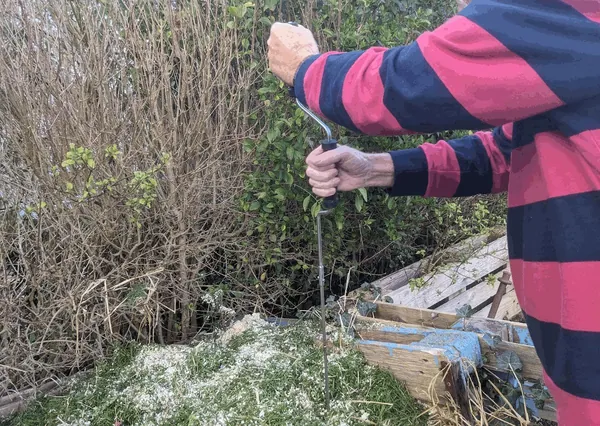
- Position the tip of the aerator against the surface of your compost
- Apply downward pressure while rotating the handle clockwise
- Keep turning as you push down – the corkscrew action pulls the tool into the pile
- Once you’ve reached your desired depth, reverse the rotation (turn counter-clockwise) while pulling upward
- Sometimes you’ll need to wiggle the tool side to side as you withdraw it, especially in dense compost
The key is to create multiple holes throughout your pile. I typically make 6-8 insertions in my pallet bin, spacing them evenly across the surface.
For folding-wing aerators:
- Push the aerator straight down into your compost until it reaches your target depth
- The wings should be folded closed during insertion
- Pull upward steadily—the wings will open as you lift, catching and pulling up material
- Sometimes you need to twist as you pull to help the wings open fully
- Once you’ve withdrawn the tool, the material you’ve lifted will fall back into the pile, now mixed with the top layer
Again, multiple insertions work best. Aim for complete coverage of your pile’s surface area.
How Deep Should You Go?
This depends on your pile size and the aerator length, but as a general rule: go as deep as your aerator allows, or until you hit resistance.
For most backyard bins, getting 2-3 feet deep is sufficient. That’s where most of the active composting happens anyway.
If you have a very tall pile (over 5 feet), you might not be able to reach the bottom with a standard aerator—and that’s okay. Focus on aerating the top two-thirds, where the most active decomposition is happening.
Frequency: How Often Should You Aerate?
I’ve found that aerating every 3-5 days after an initial turn keeps my compost pile hot and actively breaking down for about two weeks longer than it would otherwise.
After those two weeks, the temperature drops to near-ambient anyway, at which point I stop aerating and let the pile mature.
However, your situation might be different:
Aerate more frequently (every 2-3 days) if:
- You’re trying to maximize heat for pathogen kill
- Your pile has dense, oxygen-poor materials
- You’ve noticed anaerobic smells developing
- You want the fastest possible decomposition
Aerate less frequently (once a week) if:
- You’re doing slower, cold composting
- Your pile has plenty of bulking material for airflow
- You don’t mind waiting longer for finished compost
You might not need to aerate at all if:
- You’ve built your pile with good structure and lots of bulking material
- You’re willing to wait for slow, passive composting
- You turn your pile regularly anyway
Remember: oxygen is crucial for good composting, but there are many ways to introduce it. Aeration is just one tool in the toolkit.
Compost Aerator FAQs
Do I really need a compost aerator?
No, you don’t strictly need one. People have been making compost for thousands of years without specialized tools.
That said, a good aerator makes life significantly easier if you’re actively managing your compost. It lets you introduce oxygen without the heavy work of turning the entire pile, which is especially valuable between turns or if you have physical limitations.
If you’re doing passive, slow composting where you just let things break down over 6-12 months, an aerator probably isn’t necessary. If you’re trying to make hot compost quickly or maintain active decomposition, it’s a genuinely useful tool.
What’s better: a compost aerator or a pitchfork?
They serve different purposes and aren’t really comparable.
A pitchfork is essential for turning your compost—physically moving material from one place to another, putting the outer layers into the center, and thoroughly mixing everything. An aerator is for aerating between turns—introducing oxygen to keep the pile active without doing a full turn.
In my practice, I use both. I turn my compost once with a fork, then use an aerator every few days for the next two weeks to keep it hot and decomposing actively.
If I could only have one, I’d choose the fork—it’s more versatile. But having both gives you the most control over your composting process.
How often should I aerate my compost?
It depends on what you’re trying to achieve.
For hot composting where you want maximum speed and heat: aerate every 2-4 days after an initial turn.
For general active composting: once or twice a week is usually sufficient.
For slower, cold composting: you can aerate weekly or less, or skip it entirely.
I’ve personally found that aerating every 3-5 days keeps my pile actively composting for about two weeks longer than it would without aeration. After that point, the benefits diminish and I let the pile mature without further intervention.
Can I use an aerator in a compost
You can, but it’s usually not necessary or particularly effective.
Compost tumblers are designed to be rotated regularly, which provides mixing and aeration as part of their basic operation. Using an aerator inside a
The exception might be if you have a very full
Will aerating alone replace turning my compost?
No. Aeration and turning serve related but different purposes.
Turning achieves several things:
- Moves outer material to the hot center (and vice versa)
- Thoroughly mixes all materials
- Lets you check and adjust moisture
- Breaks up clumps and redistributes bacteria
Aeration primarily introduces oxygen to keep bacteria active.
In my experience, you still need to turn compost at least once for best results. Aeration can reduce the number of turns required (I’ve gone from turning twice to turning once, then aerating regularly), but it doesn’t eliminate turning entirely.
The closest you can get to no-turn composting is to build your pile really well from the start with plenty of bulking material. That creates enough natural airflow that you might not need to turn or aerate at all. But that takes careful planning and the right materials.
My aerator’s blades don’t always open – what am I doing wrong?
This is a common issue with folding-wing aerators, and I’ve experienced it myself with the Darlac.
Usually it happens because:
- The compost is too broken down: When material is already fairly decomposed, there’s not enough structure for the blades to catch on. The tool just slides up without the wings opening.
- You’re not pulling firmly enough: The wings need resistance to open. If you’re pulling too gently, they might not catch.
- The material is too wet and slippery: Very wet compost can cause the blades to slip rather than catch.
Solutions to try:
- Work in fresher, less decomposed compost where possible
- Pull more firmly and steadily when withdrawing the tool
- Twist the aerator as you pull upward to help the blades catch
- If your compost is very wet, wait a day or two for it to dry out slightly
With corkscrew-style aerators (like the Ejwox), you might notice the tool doesn’t release cleanly from the compost. Just wiggle it side to side as you withdraw it, and it should come free easily.
Related Posts
- EJWOX Compost Aerator Review: Worth the Investment?
- Darlac Compost DP788 Aerator Review
- 11 Ways to Aerate Your Compost (10 Don’t Involve Turning!)
- Optimizing Oxygen: Understanding the Role of Air in Making Compost
- How Often Should You Turn Compost?
- Compost Tools for Better, Faster Compost
- Best Compost Thermometer – tried and tested